
Gregor Jelnikar (Georgie Bistro)
On the occasion of the third anniversary of his Bistro Georgie, we sat down with Chef Gregor Jelnikar to talk about the journey so far and the steps they’re planning for the future. In recent years, the bistro has established itself among both locals and international visitors as a reliable, high-quality choice for a bistro-style lunch or an elegant tasting dinner. He shared the changes they’ve experienced along the way, the values and goals they remain committed to, and what we can expect in the near and more distant future.
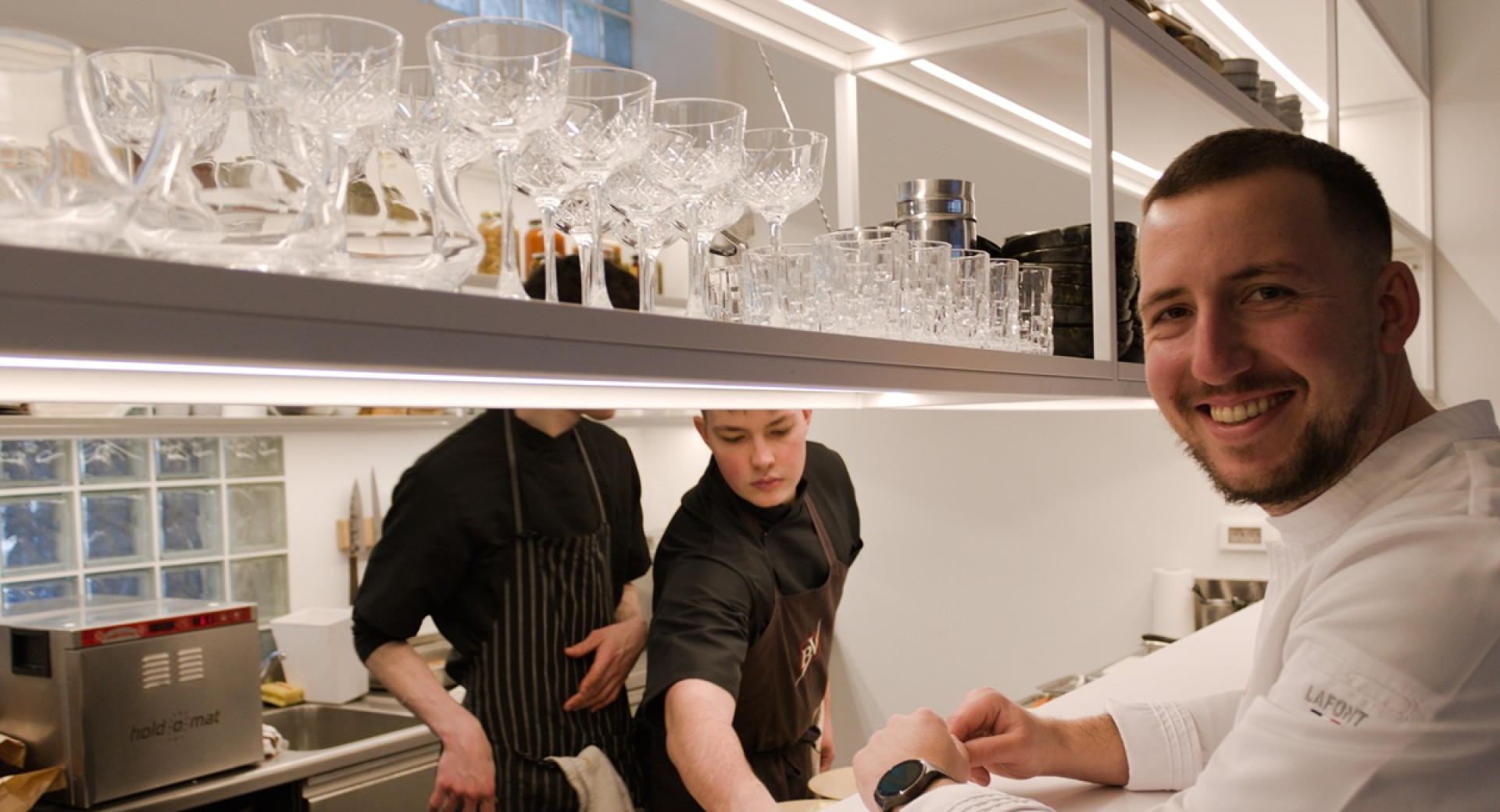
© Suzan Gabrijan
Georgie Bistro recently celebrated its third anniversary. In that time, you’ve firmly established yourselves as one of Ljubljana’s most popular foodie destinations. What has changed the most since opening? What has remained constant? Looking back at the beginning and your expectations then - did anything completely surprise you?
Let me start at the end - with what surprised me the most, and in a positive way. In the beginning, we expected significantly more demand for lunches, as they’re more affordable, but it turned out there’s actually even more interest in tasting dinners. That allowed our identity and vision to evolve more clearly towards a fine dining restaurant, moving away from the initial idea of a more mass-oriented lunch bistro. From a creative standpoint, that’s definitely better for us.
I’ve also noticed that the ratio of local to international guests is almost reversed between lunch and dinner. At lunch, about 80% of guests are Slovenians, while at dinner it’s roughly 80% international visitors. Tourists in Ljubljana seem to look for dinner experiences, when they can unwind at the end of the day, while for lunch they prefer quicker options. Our lunches aren’t exactly quick - enjoying three courses at a normal pace usually takes between an hour and an hour and a half, which is often too long for visitors on a tight sightseeing schedule. Locals, on the other hand, tend to dine out less during weekday evenings, though weekends are different - on Fridays and Saturdays, about half of our dinner guests are locals.
There have been some changes since the beginning, though not in the core concept. We added two tables that weren’t part of the original plan with the architect, and they’ve actually become some of the most popular - one by the window, the other tucked behind a cabinet, where there used to be an armchair for guests waiting for a table and enjoying a cocktail. We expanded our tasting menus from the original 5- and 7-course options to include a 9-course menu, added another signature dish to the regular menu, and increased the number of wine labels - something that had always been a quiet ambition of ours.
We’ll continue developing in that direction, but it takes time. It’s a kind of natural evolution, as we purchase and store all the wines ourselves - we started with two wine fridges, and now we have three in the bistro, plus an additional one in storage for archival wines and champagnes.
Georgie is featured in the Michelin Guide, you joined JRE last year, and you’re also one of the highest-rated restaurants in Ljubljana on Google. How important are these recognitions to you, and what matters most personally as a sign you’re on the right path?
All of these are strong indicators that we’re on the right path-achieving them was one of our goals, and we were happy to reach it already in our first year. If the Michelin Guide hadn’t recognized us as a quality restaurant, we might not even be here today. Our first major increase in business came when we were included in the guide.
We were new, and Slovenians can be quite cautious at first-it takes time for them to embrace something new. To get on the radar of international guests, you need strong visibility on Google-meaning lots of good reviews - or recognition from a trusted guide.
After three years, we also joined JRE. From a business perspective, that’s less crucial, but personally it means a lot to me. I enjoy being surrounded by like-minded people who share similar values and goals, and it’s also important for the team. The bistro was always designed to function and survive even without me, so having a strong, satisfied team is essential.
Last year, you also organized several special events in collaboration with other Ljubljana restaurateurs. These seem to be well received and add something fresh to the city’s culinary scene. How do you balance bistro lunches, tasting dinners, and these more relaxed gourmet events?
If you want to maintain a high level for dinner service, lunches and events need to meet similar standards. Every event you test teaches you something. For example, last June we organized an event combining burgers and champagne, inspired by a similar concept in Champagne, France.
It sounds simple, but it’s actually quite difficult to put burgers on the same level as champagne. Our idea was to show that champagne, despite being considered a premium drink, can pair beautifully with food that’s usually seen as casual or street-style - and that you can enjoy that combination in a relaxed, social atmosphere, outdoors, with a DJ.
We didn’t want to create these events alone - we wanted to build a sense of community, so we invited neighboring chefs and restaurants to join us. We repeated the event several times last year, but this year we plan to organize two at most, otherwise they lose their charm - one at the end of June and another in early September, when locals return from holidays.
These events are primarily for locals. Tourists tend to find us anyway, and of course we’re happy to have them, but Slovenian guests are the most important to us, and we want to offer them even more.
Your menu is deeply rooted in Slovenian ingredients, with a strong focus on seasonality and quality. What does your creative process look like when developing new dishes?
It’s actually a mix of approaches - and even a third one. Sometimes we take a traditional or well-known dish and deliberately reinterpret it. For example, one of our recent desserts was inspired by the flavors of potica-walnuts, poppy seeds, cottage cheese, apples - but presented as a dumpling with walnut ice cream and caramelized apples. The flavors are traditional, but the final dish is a new interpretation.
Other times, we highlight an exceptional ingredient and build the dish around it with seasonal elements. And sometimes inspiration comes from travel - we then recreate more “exotic” dishes using local ingredients. One idea I’m still working on is a green papaya salad - but since I don’t want to use actual green papaya, I’m searching for a local alternative. Kohlrabi has come quite close.
You also place strong emphasis on drink pairings - Slovenian wines and signature cocktails. What trends are you noticing among guests?
We follow trends closely. One clear shift in recent years is a reduced interest in heavy, macerated wines. Guests are increasingly choosing lighter, more drinkable wines with lower alcohol content—even when it comes to reds.
The cocktail scene is also developing rapidly, and we’re lucky to have Janez on our team focusing on that. When it comes to pairings, international guests are more open - they’re happy to trust us. Our standard pairing features exclusively Slovenian wines, allowing them to explore different regions.
Slovenians tend to play it safer - they’ll order a bottle or choose individual glasses they already know. Janez and I design the pairings, but we always want input from the whole team - everyone involved needs to believe in it and present it with confidence.
You’re very active on social media, sharing not just dishes but also recipes and kitchen tips. How important is digital presence for your visibility and success?
Very, very, very important. My partner comes from a marketing background, and I also have experts in the family, so I’m familiar with the “healthy percentages” that should go into marketing - and we stick to them.
That doesn’t mean we spend on ads, but we invest in high-quality content. We’ve made a conscious decision to be transparent, to share knowledge openly - that’s the only way to build awareness around quality gastronomy.
We’ve noticed people engage more with recipes and tips than with explanations of dishes, even though we might prefer the latter. At the same time, we need to consider international audiences-videos in Slovenian won’t interest them, but they do look for information about the food.
So it’s about balance: video content for followers (mostly Slovenians), and dish photography as informative content for occasional visitors.
Looking ahead - what’s your vision for Georgie? Any ambitions for 2026 and beyond?
Georgie was never conceived as a single, fixed concept. It will always exist at its current location, but we want to expand the name into other directions. Maybe the bistro will move, and this space will become a dedicated fine dining restaurant aiming beyond just a Michelin recommendation. Maybe one day there will be a smaller Georgie wine bar.
Those are long-term ideas. This year, our focus is on improving what isn’t yet optimal - especially acoustics. The space gets lively and quite loud, which can be challenging for guests seeking a more intimate atmosphere.
That said, we don’t want to become overly formal or exclusively romantic - we want to remain a place where people have fun, where music can be a bit louder, where the sounds of the kitchen are part of the experience. Our main focus remains food and wine. By not over-investing in less essential elements, we can keep prices more accessible. That’s a conscious choice - we are, after all, a bistro.
Finally, your favourite spots in Ljubljana? Where would you send someone visiting for the first time?
We’re actually working on a small joint project - a recommendation leaflet with other restaurateurs. We often get walk-in guests we can’t accommodate, and they ask for suggestions.
For lunch or dinner, we recommend TaBar and Aftr nearby. For fine dining, JB Restaurant and Strelec. For something more relaxed, Striček is a favourite for lunch among many of us, and Mihovec is great for a Sunday meal.
Personally, if I’m picking up my kids midweek and want a glass of wine, we go to Kletvica. For beer, I like Lajbah. For breakfast, Le Petit. I also enjoy Zanoodle, Raw Pasta, or Vito Maccheroni if I’m in a hurry. Coffee at Čokl or Stow.
That said, the overall selection is still quite limited. I think Ljubljana could use more high-quality options.