
JORG ZUPAN (ATELJE)
In June of this year, Slovenia was delighted by the eagerly anticipated first Michelin Guide, which bestowed seven of its prestigious stars among six Slovenian restaurants. The recipients include Atelje from Ljubljana, where chef Jorg Zupan and his team create seemingly simple dishes, enriched with extensive knowledge and ingenious ingredients. We talked to Zupan about the stars, trials and tribulations of 2020, Slovenian and foreign guests, the challenges of cooking seasonally and the development of the Slovenian culinary scene.
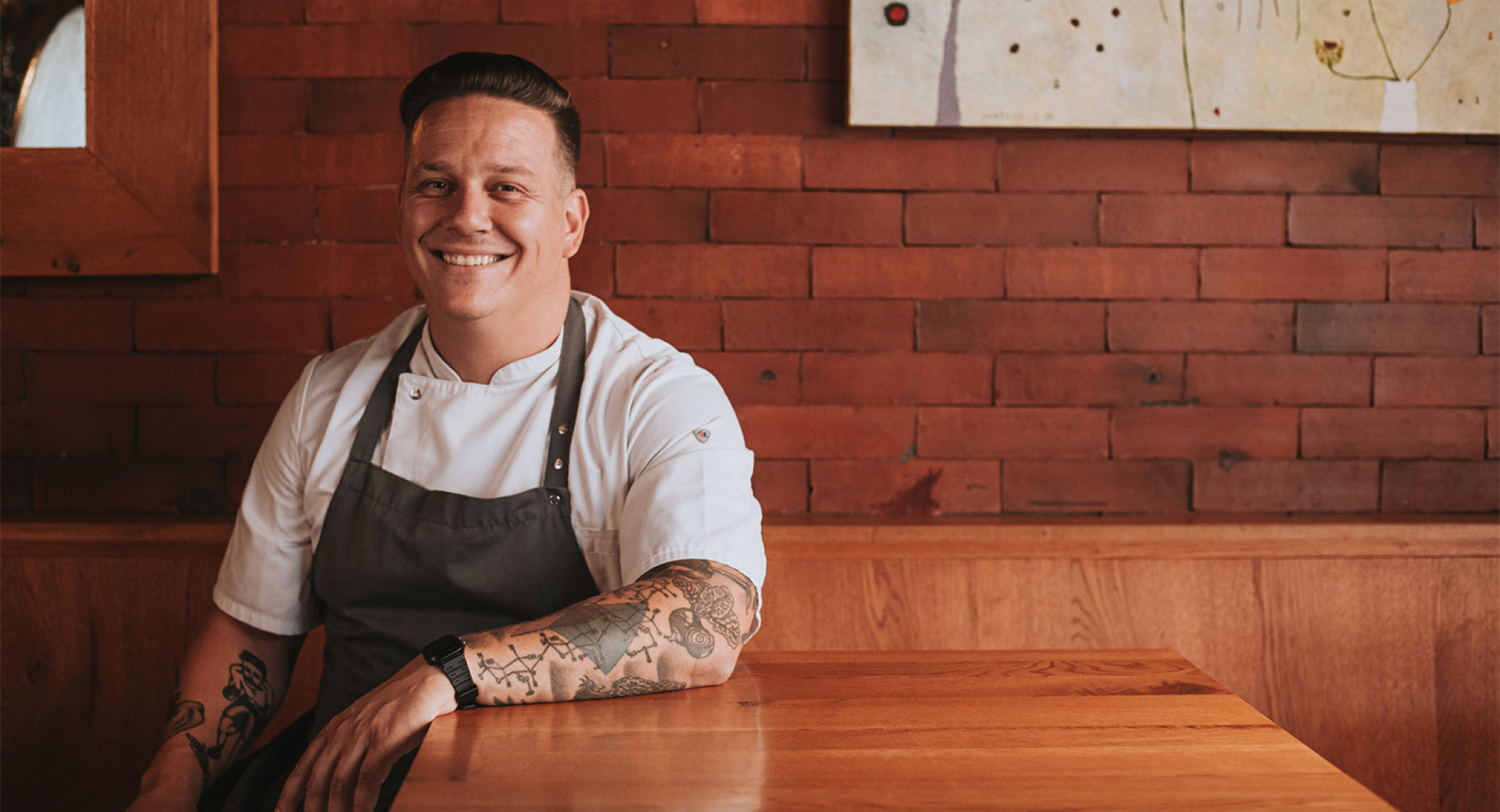
Although the year 2020 is presenting us with many challenges, it’s surely one of your best yet, at least from one aspect – you received your very first Michelin star! What were your feelings right after you found out, and what are your feelings now, three months later? How did this prestigious award affect everyday work at Atelje?
It was an incredible feeling. Quite honestly, we didn’t expect to win a star, but we wanted to, very much so. In light of the three-month closure our thoughts were mainly focused on the continued existence of the restaurant and taking care of our employees. I was shocked upon hearing the news, but in a good way. Michelin stars are like the Oscars for chefs and restaurants, but I’m certain we’ve earned it. The feeling when they announce your restaurant and you find out you’ve been given a star is incredible. It’s priceless.
How did you cope with the quarantine period and the subsequent months at the restaurant? Did the fact that you were the Michelin star recipient ease your survival during those months?
Receiving the star contributed quite considerably to our post-quarantine survival. Pessimistic predictions, border closings and fear of travel made us uncertain as regards our future, as restaurants in Ljubljana depend heavily on foreign guests. Unfortunately, we are not close enough to the border to be able to rely on guests from any of the neighbouring countries. Just as we began adapting our menus to local guests, the Michelin star resulted in many bookings practically overnight, and so we were able to work well throughout the season. Sadly, the same difficult situation has now returned, and we are again facing uncertain times.
Years ago, you transformed Smrekarjev Hram to Atelje. What was the vision that led you in your very own restaurant? Have you changed and built upon it since then, or do you remain faithful to the path you originally set out on? Has the star changed it at all?
Originally, the vision was not mine alone, as I had to adapt considerably to the hotel that still owned the restaurant at the time. Upon taking over the restaurant, the vision somehow evolved organically. We still stick to the principles we set out to implement initially, namely that the setting should be nice and relaxed, that people should feel good in it and, above all that the food and the service should be at the highest possible level. But we have to continuously adapt to the market and to the guests’ needs and wishes, which is why our vision develops all the time as well. Rather than changing this, the star consolidated and confirmed it.
Upon taking over the restaurant, your business partner Matjaž Ivanc and you began seeking balance between work in the kitchen and service, and the business side of running a restaurant. Do you strictly separate creative work from business, or do these two poles intertwine in your everyday life? And does the balancing of the two ever present a challenge for you?
I’m in charge of the creative side, especially in connection with the kitchen and, at least conceptually, the service. I prefer leaving the business side to Matjaž, although we constantly learn from one another, as it’s impossible to completely separate the two sides. Taking care of guests is a business where one needs to be skilful at both. That’s why this is one of the most arduous professions.
Art plays an important role in your work, as the name of your restaurant suggests. How much art is there in cooking in your opinion, and how much technical knowledge?
It’s true, I often hear that chefs are artists (laughter). We could say that it’s a kind of art, as it evokes certain feelings in a person. We create experiences. Experiences that, although brief in nature, guests remember for a long time when we do things right. Through food and flavours we want to evoke sensations, awaken memories – this is precisely why cuisine can become art. However, an artist will be hard-pressed to create without some kind of technical knowledge. Had Picasso, Rembrandt, Van Gogh, Basquiat, Pollock or Kvium no technical skills, they would probably not be able to create such works of art. Naturally, styles and approaches differ somewhat, but each perfected certain techniques in their own way. The same applies to cooking, only the life span of our products is not as long. Everyone tries to use their knowledge to create something beautiful, something that stirs emotions. Technical knowledge and an artistic sense go hand in hand in cooking, too.
What combination of a plate and wine from Atelje’s current menu would you highlight as your favourite work of art?
There are several. For example, cabbage baked in hay, which we round off with hay butter and finish off by baking on charcoal. We add a reduced buttermilk and brown butter sauce, roasted pine nuts and dried porcini crumbs. The result is a completely meat-free dish, whose texture and abundant umami are reminiscent of meat. We serve it with a glass of Vitovska Grganja, vintage 2017, from the Vina Štemberger wine cellar. The bomb!
Another one of our classics we’re known for is glazed lamb sweetbreads with black garlic wrapped in lightly grilled iceberg lettuce. To this we add vadouvan, a sauce from a blend of spices and aromatics. We serve this dish with Akord by Šturm. Crazy delicious!
Over the past few years, Ljubljana has hosted many guests from abroad, especially in the summer, which must have been reflected in Atelje as well. Due to the current situation, the restaurant’s clientele is surely predominantly local, which offers an interesting comparison. What is the most noticeable difference between foreign and local guests?
Ljubljana is typically visited mainly by guests who come here just for a few days and plan a visit to our restaurant especially. They mostly already know about us and book a table, guests who can spontaneously treat themselves to a dinner in a high-end restaurant during their travels are rare. I suppose that’s why such guests are very reverential and grateful. We are very affordable to them, and many return every year.
Before local guests seldom showed interest in us, which changed slightly after receiving the star. I think it’s a more short-term interest along the lines of “let’s see what this Michelin star restaurant is all about”. I suppose Slovenians are still getting accustomed to creative cuisine and haven’t quite relaxed yet.
You always emphasise that you strive to include as many local and seasonal dishes on your menu as possible. What will you be cooking in the coming months? Are your thoughts already on winter menus or are you still revelling in autumn’s abundance?
Autumn is my favourite season. Granted, spring and summer outdo it with their abundance of seasonal ingredients, which is sometimes even a bit of an obstacle because you have a hard time deciding what to make. But the autumn is always surprising with more complex ingredients. Pumpkins, chestnuts, pears, apples, the last of the plums, mushrooms, cabbage, and so much more. There are a lot of earthy, sweeter flavours that are really comforting on colder days and evenings. Given the mild winters we’ve been having lately, I hope the autumn repertoire lasts as long as possible, because real winters make it difficult to create menus and require a lot of ingenuity. That’s why a lot of preparation is needed for the colder months of the year – pickling, fermenting, drying and similar practices really come in handy.
The Slovenian gourmet scene has been evolving recently and establishing itself faster than ever before. This year, we received our first Michelin Guide, the Slovenian Gault&Millau guide has come out twice, and Slovenia is set to be the European Region of Gastronomy in 2021. Do such activities affect you?
The battle for attention and exposure is still prevalent in the Slovenian gastronomic arena... after all, this is still a business, and we must act accordingly. Any mention in a renowned guide or participation at an event is great, as it enables us to show ourselves and make the public take note of our work. Such activities are therefore more than welcome. But it is important for the guides to be independent and unbiased, as an area as small as ours lends itself well to the exploitation of personal interests and suppression of the advancement of new, young and innovative restaurants and chefs, and relying on who one knows and what prior deals have been struck. That’s why I prefer foreign guides, as I feel their ratings are more objective, realistic and, above all, fair.
Atelje is joining the November Gourmet programme with intriguing, locally inspired special creations. Can you tell us more about what you’re cooking up?
It’s true, in the spirit of the current situation, which is unpredictable (to put it mildly), we have devised a special experience, aiming to connect the tastes of Ljubljana with their sources, producers and suppliers, with whom Atelje has fostered successful collaborative relationships. We have thus prepared an Atelje Gourmet Box, which is perfect for the only kind of meals that are still allowed, namely meals at home, in the company of our nearest and dearest. The package includes eight cold starters made from local and seasonal ingredients, a loaf of our homemade bread, and a bottle of wine that rounds off the entire experience perfectly. Curious eaters can pick up the Atelje Gourmet Box at our restaurant or have it delivered – all the information is available on our social media, of course.