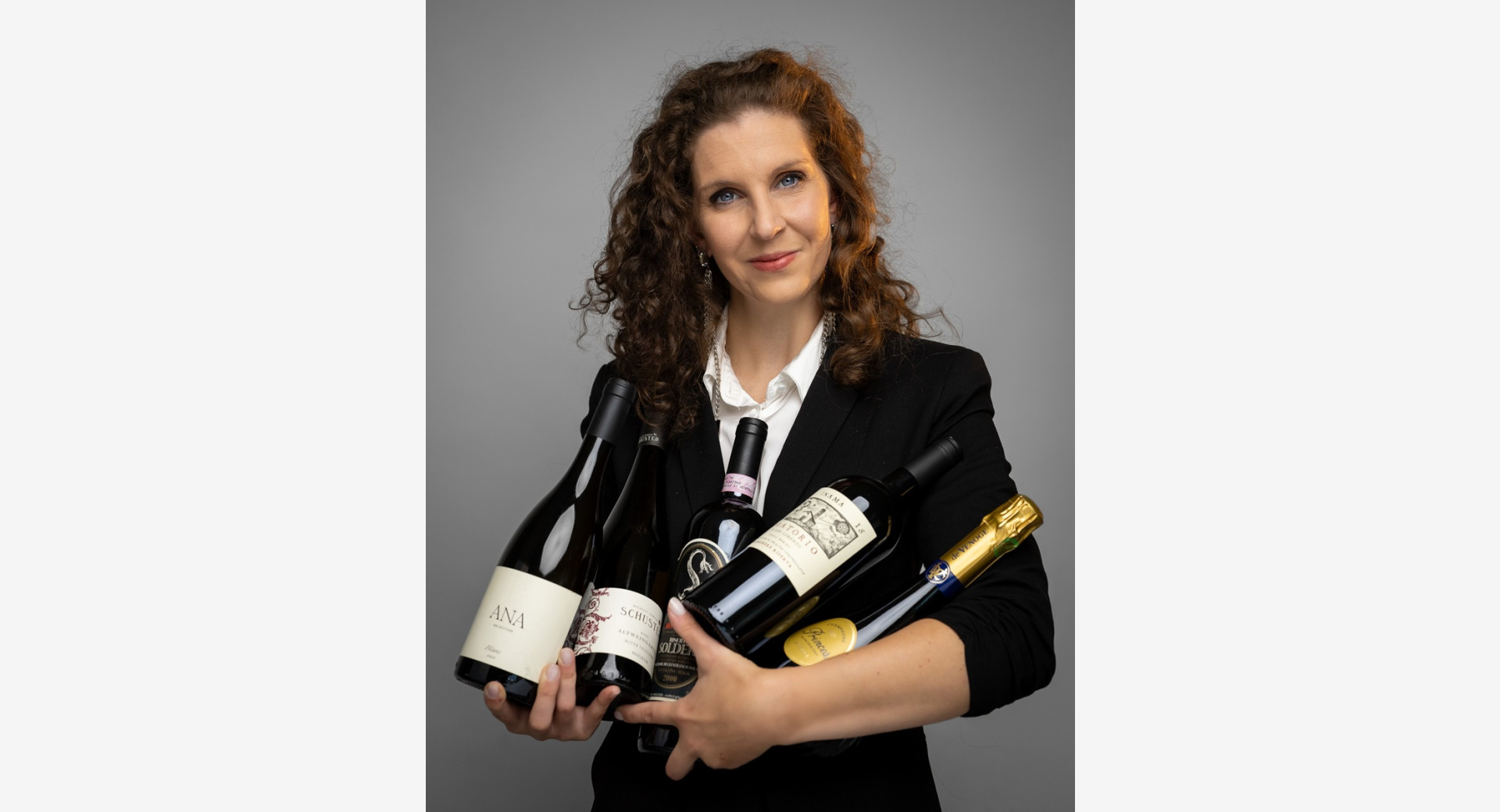
Simona Česen (Wine Bar Šuklje)
We sat down with Simona Česen, 2025 national sommeliership champion and head sommelier at Ljubljana’s Wine Bar Šuklje, to talk about what her job really involves, the skills it demands, and how sommelier competitions work. In an engaging conversation full of insights, we also explored the rising role of women in the wine world, the evolution of Slovenia’s and the global wine scene, and how sommeliers help share knowledge and expand public appreciation, playing a key part in cultivating a richer wine culture.
Simona, being named Slovenia’s best sommelier is a huge achievement. What actually changed for you the morning after the announcement, if anything?
Certainly, it brought more recognition, both for me and for the wine bar. It also gave me a new goal: competing at the European and World Championships to continue improving my skills. When I first entered the national competition, the goal was obviously to win, but in these contests, there are so many factors that determine the winner. At the European and World level, there will be even more, so thorough preparation is key… and then we’ll see. You never know.
I wouldn’t say my everyday life has changed drastically, but I do notice a lot of praise and congratulations from women who are proud that, as the first woman in this “male-dominated world,” I earned the title. Overall, I see this trend changing, even if it’s not immediately obvious. There are more and more women in the wine world—for example, Veronika Frelih, actually two generations of Veronikas, mother and daughter; at Šuklje, Katja is one of the driving forces; in Brda we have Dušica Šibav, who was recognized as a young winemaker. Among sommeliers, there’s Nina Bratovž, named sommelier of the year by Gault&Millau and JRE, and also Vanesa Centrih at Vila Planinka on Jezersko, Špela Šuc from Gostilna pri Mari, Mojca Trnovec from Gostilna Mihovec, Mateja Markič from Restavracija Tabor. Slowly, this is making an impact. That said, there are still not as many women in high-level bars.
It’s lovely to hear these kind words, but I still feel a natural doubt, how could I really be the best?It’s lovely to hear these kind words, but I still feel a natural doubt, how could I really be the best?
How does the competition actually work? Do you enter yourself, or does someone else enter you?
The competition is organized by Sommelier Slovenija, which is a member of ASI, the Association de la Sommellerie Internationale. ASI organizes the European and World championships. Because the Slovenian organization is part of the international one, they can select us to participate in these further competitions. The European and World championships are independent of each other, so you don’t have to compete in the European one first in order to enter the World championship. You submit the application yourself, though colleagues can of course encourage you to do so.
The semifinals are a written test that lasts just under two hours. It covers sommelier knowledge, which isn’t just about wine, but also other beverages like spirits, non-alcoholic drinks, and water, as well as food and pairing wine with it, cigars, oils, vinegars, really a wide range. This is followed by a blind tasting of two wines, one white and one red, which must be described in detail, and a dish, for which you have to choose and justify which wine you would pair it with. We were also tested on decanting, which involves removing sediment while pouring wine from the bottle into a decanter and serving it to a guest.
In the final, there is a blind tasting of four wines and identifying them, a blind tasting of three beers and five spirits in black glasses, and correcting a wine list, for example spotting mistakes in vintages, wineries, wine names, regions, or countries. Decanting is also part of the final, accompanied by an additional guest question. At the end, we had five minutes on stage to present the wine pairings for the entire menu, with at least one wine coming from Slovenia. I feel this was the task I performed best, as I included the full restaurant experience, which doesn’t start with the appetizer or end with dessert, aperitifs and coffee are part of it, and I even added a cigar.
You work in Ljubljana, a city where wine culture is becoming increasingly confident. How would you describe the city’s wine identity today in one honest sentence?
I would say that the city doesn’t have a single wine identity, each wine bar tells its own story. If you like natural wines, you can try Kletvica or Supernatural, for social gatherings Šuklje is a great choice with plenty of space and a wide selection, Movia is a family-style bar with an excellent selection. There are more and more small bars, each a little different, which gives wine lovers the chance to choose depending on their mood – there’s always something for everyone.
Wine Bar Šuklje has become one of the city’s go-to spots for wine lovers. In your opinion, what do guests feel when they sit down there for the first time?
I would say they feel the energy within the team, because even when I visit other places, I always notice how the staff interact with each other. At our bar, the team spirit and relaxed vibe really stand out. Another thing is definitely the incredibly extensive wine list, which includes wines from Japan, Mexico, Lebanon, and a mix of Slovenian wines that come both directly from winemakers and from various distributors. The combination of this energy, the selection, and the knowledge of our staff – everyone working with us has at least a WSET Level 2 certification – really makes a difference. More teams are getting trained like this nowadays, but bars like ours are still rare, and I would say we are among the stronger ones. Among our sommeliers, we even have two PhDs in oenology, which adds an extra dimension to our expertise. So anyone can come in, from a complete beginner to a connoisseur, and they will always find someone to talk to.
The role of a sommelier has changed quite a bit over the past decade. Which part of this profession do people still often misunderstand?
Some people still imagine a sommelier as just a waiter, which is a common assumption in Slovenia, but at its core a sommelier is responsible for all drinks – alcoholic and non-alcoholic, wine and non-wine pairings. Since we are a small team, these duties sometimes overlap with service, but a sommelier has many other responsibilities: updating vintages, storing wine, discovering new wines and winemakers – in Slovenia, for example, only about twenty names are widely known, but there are many more excellent producers. When it comes to the guest, our main task is education – not just about how and what to drink, but also for the future: how to store wine at home, how to start a personal collection. These kinds of things are what really distinguish service from true hospitality.
Slovenian wines are no longer a secret in the world. What would you like foreigners to better understand about Slovenia as a wine country?
The first question is how many tourists even realize that Slovenia is a wine country. Some are already surprised that Slovenian wines exist at all. Another point is that although we are a small country, we are divided into three completely different wine regions, and even within those regions there is a lot of diversity – so in the end, despite our size, the variety is truly impressive. To compare briefly, Burgundy is larger than Slovenia and mainly focuses on just four grape varieties, whereas we have around twenty.
We have beautiful sparkling wines from Dolenjska, Blaufränkisch that are stylistically similar to Pinot Noir and easy to introduce to foreigners, rich red wines from the Primorska region, fresh whites, the spectrum is really wide, and that is wonderful. I would especially recommend that foreigners take a few days to explore Slovenian wines and visit different regions, because no single tasting, no matter how exceptional the winemaker, can cover the full range.
Are there wine styles or regions in Slovenia that you feel do not get the attention they deserve, even among local wine lovers?
In my opinion, Posavje and Podravje do not get enough attention. Part of this comes from our history – for example, Laški Rizling, a truly beautiful variety, had a bad reputation during the Yugoslav era because “every cheap wine” was bottled as Laški Rizling. Older generations therefore tend to avoid it. But things are changing with younger generations, who want something new – if my parents drank cviček, I wouldn’t want to, at least until I discover it can actually be good.
Blaufränkisch is definitely an overlooked variety that is slowly gaining recognition, as is the previously mentioned Laški Rizling. From Štajerska, Šipon is becoming more popular, and in Primorska Refošk is a challenge because people often have had bad experiences with it, even though it can be excellent. Sometimes you have to offer a wine blind first, and only once the guest enjoys it do you reveal the variety, so they can approach it with an open mind and change their opinion. I am happy to see Zelen, a nearly extinct variety, on the rise because it has incredible range.
A lot depends on guests’ perceptions and desires, as well as on the approach of waiters and sommeliers – how wine lists are curated, what the vision of the bar or restaurant is. If we keep selling the same safe options, change cannot happen. But if we take a few risks, educate guests, and expand knowledge, we can achieve a lot. We also notice that young people are drinking less alcohol, and there is a growing trend of non-alcoholic wines, which personally I usually pass on, but I try them nonetheless. I believe that in the long term the concept will remain, similar to non-alcoholic beer or decaf coffee for those who need to avoid alcohol, but classic wine will still hold its place.
Ljubljana has many wine bars, each with its own character and story. In your opinion, what makes a wine bar truly great?
Professionalism in terms of knowledge and service, the energy within the team, a well-curated wine list, and of course the overall atmosphere and ambiance. Many things need to come together, and in the end it’s also subjective, since we are all different and have different tastes and expectations.
Are there any wine trends in Slovenia that you like, and any that you could do without?
As I said, for me, non-alcoholic wine could disappear (laughs). On the other hand, I’m happy to see a return of small, old grape varieties. Wherever you go, you can find some tiny, indigenous, almost obscure varieties. For example, the Greek roditis, which is hard to find but incredible, or oseleta from Italy’s Veneto region, and there are many others. Regions are starting to realize how important these local specialties are and are working on them. The greater the diversity, the better it is for everyone, including the whole ecosystem.
What usually guides you when selecting wines for the bar: the winemaker, the story, the style, or how the wine performs at the table? Or something else?
Because we have such a broad wine list, every so often we need to remove some bottles, which always tugs at my heart, since each wine has its own story, its winemaker, its family. But sometimes changes are necessary.
For a wine to make it onto the list, it really has to excite me. For example, I know many rebulas, but some are truly special. I don’t want ten similar rebulas from different winemakers in our cellar; I want as much diversity within the variety as possible. That way, we can show our guests the full range of what the grape can offer.
When we put together the wine-by-the-glass list, which we update about every two months, I often look for something very specific – maybe a missing style or a particular price point. We try to offer wines by the glass ranging from about €3.50 to €11, so there’s something for everyone. In these cases, I can be very technical, selecting wines based on their characteristics and price, not just the story. Of course, even these wines have their own story, and I still make a point of talking to the winemaker and presenting the wine properly to our guests.
Which wine has truly surprised you recently and why does it stand out in your memory?
The oseleta I mentioned earlier from winemaker Masi, vintage 2016, 16 percent alcohol – that one really impressed and surprised me. Often, when tasting new wines, I’m too technical and professional, and I rarely allow myself to simply enjoy a wine for pleasure, as I think we ideally should.
Another one is Vrbanjka Cor from Šuklje, definitely. Šuklje from Bela Krajina has a top line called Vrbanjka, a pinot noir from a single vineyard. In 2020, they began separating the pinot noir from the central, steepest part of the vineyard and discovered it had a unique energy, its own complexity, depth, and structure. By 2022, the rest of Vrbanjka also had enough structure to bottle Vrbanjka Cor separately. That’s when I thought, “Wow, can pinot noir really do this?” This wine is only available at Wine Bar Šuklje and at the estate in Bela Krajina, and it’s truly exceptional.
Competitions reward precision and consistency, while everyday work with guests relies on intuition and empathy. How do these two sides come together in your work?
It’s always about blending my desire to share the knowledge I gain from competitions with the focus they require. I love it when guests tell me the experience was truly educational, that they learned a lot. I also often ask the team questions, through which they gain new knowledge while I reinforce and review what I know. In the end, everyone gets something out of it and we all grow.
Sometimes, though, things don’t go perfectly – either I’m not satisfied, or the guests aren’t. Maybe they’re having a bad day that I can’t improve, or maybe it’s my own day and I’d be better off staying home. Being able to acknowledge that is already an important step.
Where do you think Slovenian wine culture will develop in the next five to ten years, and what role will sommeliers play in that?
Since the number of sommeliers and wine enthusiasts is growing, even those winemakers who haven’t yet will need to make wines without flaws. This is especially true for natural wines, where mistakes still happen too often. I hope we stay at around the 11,000 hectares of vineyards we have now – the trend is that, except in Brda, the vineyard area is slowly decreasing. Winemakers will need to focus on quality, because in the long run they will survive only with consistent, high-quality wines and a clear vision, which is often missing. It’s also important that they set the right price for their wines – it’s great to be happy with small quantities, but you also need to value your effort and the quality of the product properly.
Above all, I’d like winemakers to work together more, which is a recurring challenge in many areas, not just wine. A great example is Brda, where a few winemakers presented their wines internationally and pulled the whole region forward. In Dolenjska, two Frenchmen, François and Guillaume, came and helped move the whole region, and in other areas it was often foreigners who showed us what we could achieve, gave us momentum, and connected people who were at odds with each other. It’s a shame we don’t always see that ourselves.
A friend is visiting Ljubljana for the first time and completely trusts your taste. Where would you send them to eat, drink, and experience the city – and why there?
For discovering wine, I’d of course suggest Wine Bar Šuklje in the evening. For lunch, I’d recommend JB Restaurant or Valvas’or. If they’re up for a light hike, I’d send them to Šmarna gora at sunrise. Especially in the autumn and winter months, when Ljubljana can be foggy, the sunrises there are stunning. For those craving good Asian dishes, I’d suggest Barra, our neighbor. At the Zlata Ladjica hotel, they have very interesting breakfast options – three different ones. One starts with cold dishes like various pâtés, continues with warm items such as eggs, and finishes with a dessert. It’s a really nice concept, a true treat.