Juha Ceramics and Art Studio
Play audio recording of content
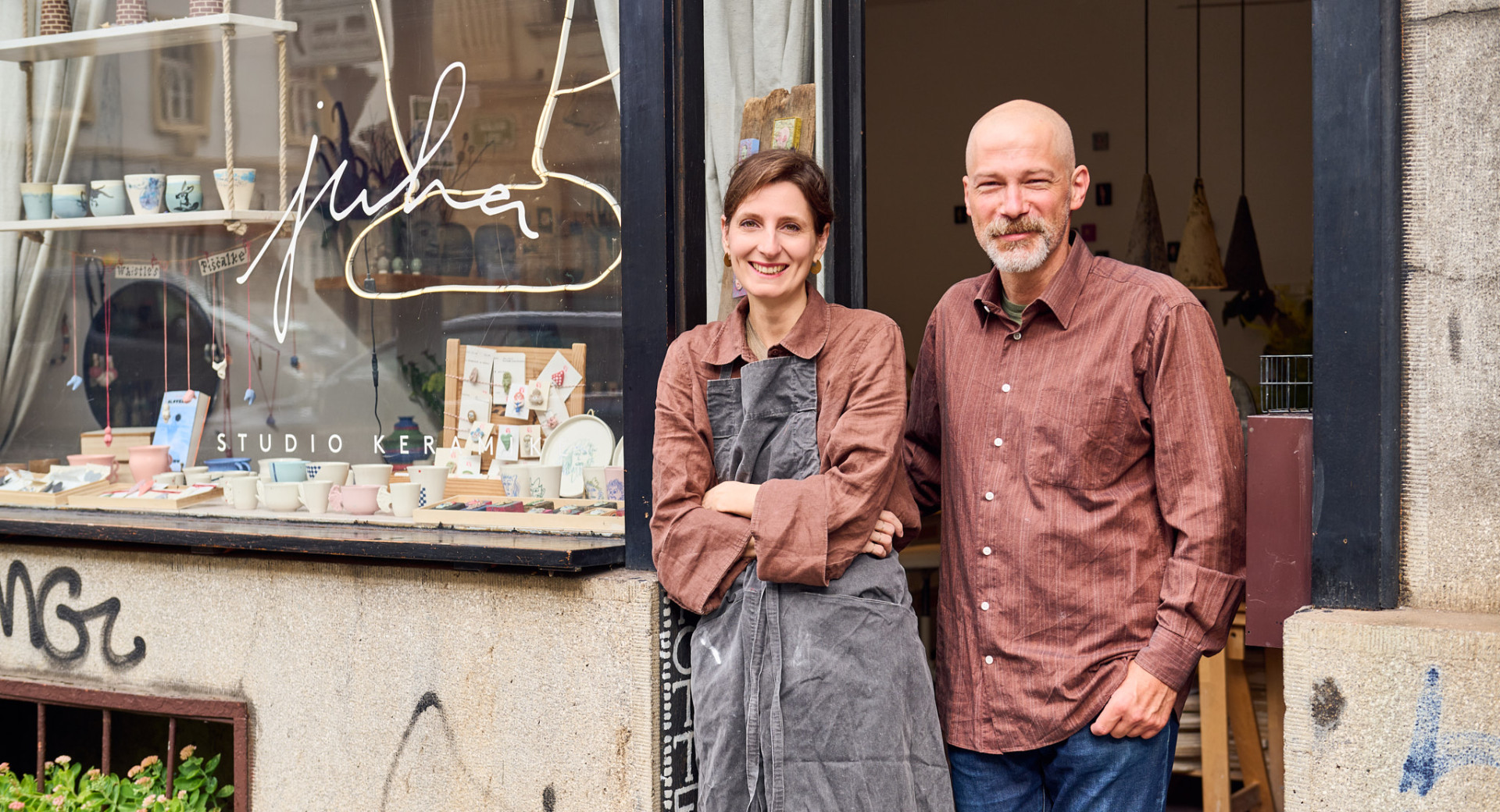
Juha Ceramics and Art Studio is a place of inexhaustible creativity. Through its wide display window on Resljeva cesta road, not far from the Zmajski most bridge (Dragon Bridge), you can see contemporary, unique and functional ceramic pieces – and, during the day, the artists whose creativity keeps the studio in constant motion. From time to time, other creators join them; at other times, an enticing smell of cooking drifts through the studio, or cheerful karaoke singing spills out onto the street. Bojana Ristevski Mlaker and Miha Perne ensure that Juha is an open and vibrant cultural meeting place – connecting creators, including hobbyists, and of course visitors who want to buy their work or simply get a small taste of the world of ceramics.
© Primož Lukežič
In December 2025, Juha Ceramics and Art Studio – both a working atelier and a sales gallery – celebrates its eighth anniversary. Its story began when Bojana Ristevski Mlaker moved from Belgrade, where she completed her studies in ceramics at the Faculty of Applied Arts. For the past three years she has been writing that story together with academic painter Miha Perne. They complement each other beautifully: she brings her education and fundamental knowledge of ceramic creation; he brings his background in fine art. And in the three years since joining Juha, Miha has thoroughly mastered ceramic techniques, while Bojana has in recent years become especially captivated by decorating and painting the finished pieces. In the last few years, Juha has also shifted its focus: clay is no longer at the forefront – porcelain is. Porcelain brings strength, purity and refinement, and has become their main medium.
Bojana and Miha, you recently created the experience titled “Create Porcelain Jewellery at Juha Studio” in collaboration with Ljubljana Tourism. What can visitors learn and make from porcelain in such a short time?
Bojana: We introduce small groups of visitors to the complete process of making porcelain pieces, from start to finish, and they also have time to create something themselves. They can make small artworks, jewellery (earrings, pendants, rings and brooches), or magnets. Two hours, of course, aren’t enough for the entire production and later glazing process, so we give them the theoretical part – and they can finish their piece by decorating it.
Bojana, you began with clay at Juha, but in recent years you’ve focused on porcelain. Why the shift?
Bojana: After years of working with clay and running clay-modelling workshops, I began thinking about what could still be interesting for people. The audience for clay workshops in Ljubljana is relatively small, and too much of the same content saturates the market. Far fewer artists work with porcelain, so I decided to pursue it. And also because I love it – it’s strong, enduring, and absolutely beautiful for painting and other forms of decoration.
Miha: Porcelain is the studio’s niche. After all, Bojana studied in this field and truly masters the craft. And it’s the finest type of ceramics – as well as an intriguing challenge. I like to say porcelain is like the princess on the pea (NB: from the story The Princess and the Pea): during the process, anything can disturb it; it remembers every single mistake we make. When the firing is finished, we’re as impatient as children when opening the kiln – we never know what we’re about to take out. Sometimes we’re convinced we’ve done everything exactly right, yet the pieces collapse in the kiln, or crack… The element of surprise is always there (smiles). In Japan, where working with porcelain is a powerful and respected tradition, they even have a god of the kiln (NB: They offer gifts and pray to him for a calm kiln, steady heat, and flawless results).
Bojana: I used to run clay-modelling workshops, but now, two or three times a year, we organise a porcelain 101 course. It’s meant for people who want to seriously learn about porcelain and how to work with it – though it can of course also be relaxing and fun. I genuinely love sharing as much as I can and passing on knowledge. Working with other creators, we also run shorter workshops: from jewellery making to decoration; in October and November we held Christmas ornament workshops, and at the beginning of December we’ll have one for children. (NB: The workshop / course space for Juha Ceramics and Art Studio is at a different location, on Tržaška cesta road.)
How open and accessible is the creators’ route to reach a broader audience or for them to have their work properly appreciated?
Bojana: We have the studio precisely so we can provide as many people as possible with a glimpse into our work. Its mission is to bring the world of ceramics and porcelain closer to people who mostly have no contact with them as artistic media. That’s why our shopfront is large and bright, and why our doors are always open – everyone is welcome. Most of the pieces in the studio are functional: jewellery, cups and plates, and painted miniatures. We have fewer sculptures on display, even though both Miha and I create them as well. The workshops and courses are another step in introducing people to what we do and in helping them understand just how much knowledge and work goes into handmade pieces.
When you opened Juha, you wished above all for it to be a place of connection…
Bojana: That wish of mine has been fulfilled. We regularly collaborate with numerous creators – from jewellery designers to painters and illustrators. We also connect with artists from other fields – for example with Klemen Košir, the author of several culinary books, with whom we cook in the studio; and we’ve even baked bread in the ceramics kiln! We’ve already hosted a culinary gathering where we invited passers-by to join us. And yes – we’ve had karaoke too (laughs).
When it comes to the culinary world, you’ve also collaborated with restaurants, for whom you’ve created quite a few unique plates and cups?
Bojana: That’s right – I’d highlight our collaborations with the restaurants Sato Bento in Ljubljana, Grič in Šentjošt above Horjul, and Mangrt in Log pod Mangartom.
Miha: When working with restaurants, I think it’s especially important to emphasise how clearly the quality and durability of our work come through. Nowhere else are plates and cups used as intensively as in a restaurant. Before buying our pieces, people often doubt how durable porcelain really is. And collaborations like these are solid proof of just how long-lasting our porcelain can be when treated with care.
What do you each enjoy most in the creative process? Which part do you look forward to the most?
Bojana: The painting. When everything is more or less done and I can finally sit down with the piece and start decorating it. Every single time, I can’t wait to pick up a new piece. The entire process of working with porcelain is long, often demanding, even physically tiring. With time you accept that this is simply how it is – but I enjoy it most when the hardest stages are behind me, and all that’s left is the artistic part.
Miha: I try to set things up so that I enjoy every part of it – though of course there are things I’d happily hand over to someone else, like unloading a hot kiln, dusty sanding, or glazing, which can be quite awkward. But there are so many beautiful stages in the process too.
Bojana: Like shaping, for example.
Miha: Actually, not long ago I started exploring the most primal ceramic technique of all: pinching. You take a lump of clay and quite literally pinch a cup into shape with your fingers. I call it evening kitchen ceramics because I do it in the evenings in the kitchen – during the day it’s more or less all about porcelain. It’s incredibly meditative (smiles).
What inspires you most in your creative process?
Miha: Everyday life and social phenomena – things like mythology and collective memory. A walk through the city. A glance out of the studio window. Life itself is often more thrilling than any film!
Bojana: I like digging into my inner world – my childhood world. Through painting, I like to express an emotion that’s directly connected to my inner state, to whatever is happening in my life at that moment. They’re often expressions. I love portraits. Sometimes they’re part-human, part-animal – caught in the emotion of a single moment.
Creativity has become increasingly emphasised in tourism in recent years – the current vision for Ljubljana’s tourism development places it front and centre. What is your view of Ljubljana’s creative scene?
Miha: Visitors from abroad are often surprised that such a small city like Ljubljana is so full of content. I think we have quite a strong creative scene. Spaces like Metelkova help a lot – there are many studios there where artists don’t pay full market rent, which allows for far more production that otherwise wouldn’t happen. And because we’re small, we’re also much more connected – we know each other and we collaborate. In that sense, we’re quite rich. We often have to find ways to support ourselves – Bojana and I have taught at the academy and done various other work related to our skills. But you can make a living – and put bread on the table from this work so to say. You just need to take action, not wait for someone else to make it happen. At Juha, we co-create the creative scene – on a smaller scale, yes, but we do.
Bojana: Exactly – because we’re in a public space and because our doors are open. In general, I agree with what Miha said, though I’d love to see many more open creative spaces like this – and for them to be much more visible.