
Studio Draž
A unique blend of family tradition, cutting-edge technology and an artistic approach
© Primož Lukežič
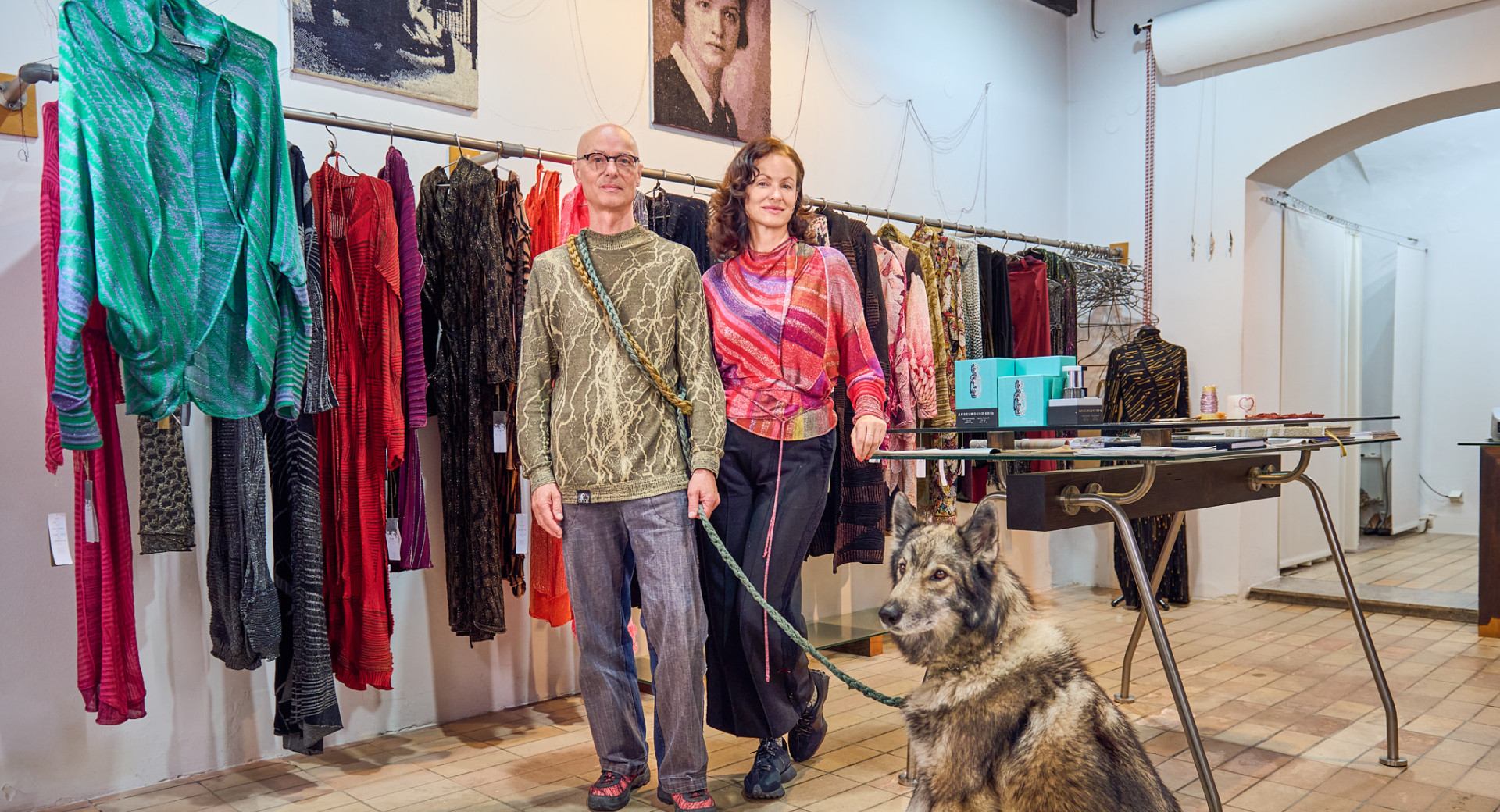
Urška and Tomaž Draž, mainstays of Ljubljana Fashion Week and recipients of numerous awards at home and abroad, have always been, above all, explorers. What began as experimentation with a knitting machine during their student years evolved into a luxury brand that does not wait for trends, but stays ahead of them through technological innovation and a sustainable philosophy. Their work is defined by a close interplay of engineering precision, artistic freedom and deep respect for the past. For more than thirty years.
Studio Draž actually consists of two spaces on Gornji trg, just a stone’s throw from the Hercules Fountain: one showcases unique garments and other fashion pieces with seamstresses working in the background alongside Urška Draž to create new designs; in the other, visitors find themselves surrounded by knitting machines and countless colourful threads – this is the world of Tomaž Draž. The siblings initially worked independently, each pursuing their own creative path, before eventually intertwining them more closely. That journey led them to create one of Slovenia’s most recognisable and reputable fashion brands.
Ljubljana’s creative scene has become increasingly visible in recent years in terms of promotion – and consequently recognition – including through experiences such as Create Your Own Shoelaces at Studio Draž, which you developed in collaboration with Ljubljana Tourism. What is your view of the city’s creative energy and its recognisability?
Urška: For far too long, there was insufficient awareness of the richness of Ljubljana’s creative world. Only now is it finally becoming clear just how many creators there are in the city who are able to make a living from their work, who are self-sufficient and independent.
You work on Gornji trg, which begins where one of the busiest parts of the Old Town – Stari trg – ends, and where, despite the number of visitors to the city, the atmosphere remains largely calm ...
Urška: We have been here for 26 years. When we first arrived, the Old Town was almost literally a ghost town most of the time. No one else wanted to come to Gornji trg. We more or less started reviving the creative spirit of this area by ourselves, a place where various crafts – as well as art – had once flourished.
Tomaž: At the time when we applied for the municipal tender for premises on Gornji trg, the Lorenz brothers were already encouraging the revival of the Old Town, including from a creative perspective. (Primož Lorenz, one of the brothers, was president of the Association for the Revival of the Cultural Image of the Old Town and founder and president of the Imago Slovenia foundation, which still organises prominent cultural events in the Old Town today.) For several centuries, Gornji trg was an artisanal quarter, and we are simply continuing that tradition. Over the course of almost thirty years, several fashion designers have been based here, but most eventually gave up and moved away.
Today, Gornji trg is home to a number of creators from different fields; last year, at the beginning of summer, you also organised a joint event for visitors?
Tomaž: That’s right. About two years ago, we joined forces and began organising a small event where we present ourselves to visitors. We invite them into our studios and ateliers and introduce them to our work.
Pletenine Draž is among Slovenia’s best-known and most highly regarded fashion brands; yet, maintaining both longevity and reputation for so long is undoubtedly an achievement. Especially in a part of the city that is far from being among the busiest.
Urška: If we hadn’t already built up a loyal clientele over the years, we certainly wouldn’t have survived. I believe we succeeded, and continue to succeed, primarily thanks to creativity, innovation, expertise, professionalism, the right attitude towards people – our employees, customers and everyone else we work with – an endless love for what we do, and perseverance. And because we have always worked with longevity, durability and sustainability in mind. Our garments are timeless – no matter how old they are. We will alter, repair or remake them at a customer’s request.
Tomaž: Our clothes are passed down from one generation to the next. We extend their lifespan.
Urška: In doing so, we have built a community of people who trust us because they know we will always ensure they can wear any garment for as long as they wish. No piece is ever truly finished – we can always breathe new life into it. That is not particularly profitable, but we do not want to measure everything in terms of money. Of course, the financial side of our work matters, but at the same time we strive to ensure our work also carries strong ethical value.
Tomaž: The fact that we are still here is also a testament to our desire for constant progress. With every collection, we want to create something new, better and different.
How do you divide the work between the two of you? On the one hand, there is the pursuit of unique patterns, cuts and designs; on the other, the constant effort to keep in step with technological advances, which play an exceptionally important role in your work.
Tomaž: At first, we each worked independently on our own collections. Over time, we realised that I was better suited to working with technology – knitting and patterns – while Urška was more drawn to working with cuts and with people. That is how we specialised and joined forces.
Urška: No garment or other product we create (N.B. Urška and Tomaž also produce interior design pieces, ranging from curtains and sofa throws to wall coverings, artworks and everyday objects) is entirely his or entirely mine. Each one is an intertwining of our knowledge, inspiration and work. Tomaž, for example, creates patterns, while I select them. Over the years, you develop a feel for which one is right – for a particular piece and for a particular person. My work also involves working with the employees who sew the garments and with our customers.
Technology provides a solid foundation from which new ideas for further development can emerge, while inspiration seems a more delicate thing – one that might eventually run dry, especially after such a long creative journey as yours?
Urška: Perhaps you are simply born with that ability – I do not know. Our grandmother remains an endless source of inspiration for us. She knew how to breathe new life into every garment. We never met her in person, but her photographs captivated us: despite an incredibly difficult life, she managed, through creativity and dignity, to ensure that she – and her three daughters – were always beautifully dressed. At the heart of inspiration is undoubtedly a constant need to explore what else you might still create. Time and again, I cannot wait to begin creating a new garment.
Tomaž: Technological progress also plays an important role in this. From the beginnings of digital photography to artificial intelligence – all of it opens up new creative possibilities. And opportunities to collaborate with creators and experts from a wide range of fields, from science to art, from mathematicians and biologists to painters. All of this continually opens up new sources of inspiration and new concepts. It is astonishing, for example, the kinds of patterns biologists discover in nature under the microscope. And then there is the Mathema Institute for the Popularisation of Mathematics, which also explores the intersection of mathematics and art. They devise mathematical functions used to create graphics within three-dimensional computer-generated space. When we first connected with them, they shared their computer programme and formulas with us so that we could reinterpret them in our own way and create new patterns.
Urška: We have come far and have enough confidence in ourselves to know that inspiration will not run dry. It has become part of our lives. We do not need to pursue it – it emerges spontaneously through work. That said, we are extremely demanding of ourselves when it comes to our work. For example, until I am completely satisfied with a garment, it will not be finished. That can mean long arguments about the garments still in progress (laughs).
Tomaž: As far as technology is concerned, we have already completed our third collection created with the help of artificial intelligence. We embraced it with open arms as a highly effective and creative tool. I am curious to see what further possibilities it may still offer us – possibilities we cannot yet even imagine.
Urška: Artificial intelligence will never replace human craftsmanship. But it can help us achieve better results.
To return, finally, to the Create Your Own Shoelaces experience at Studio Draž: how did you decide on shoelaces, and what do visitors experience and discover during the workshop?
Urška: Shoelaces are relatively simple to make, yet they are also a subtle detail that can have a striking effect on a person’s style. They can completely transform and elevate the appearance of footwear. The experience itself focuses primarily on presenting our collections, inspirations, technical expertise and practical work. When we present all of this to the foreign visitors who come to see us, and when we help them choose threads for their new shoelaces, they are delighted and surprised. They tell us they have never visited – or even encountered – anyone who works the way we do.
-
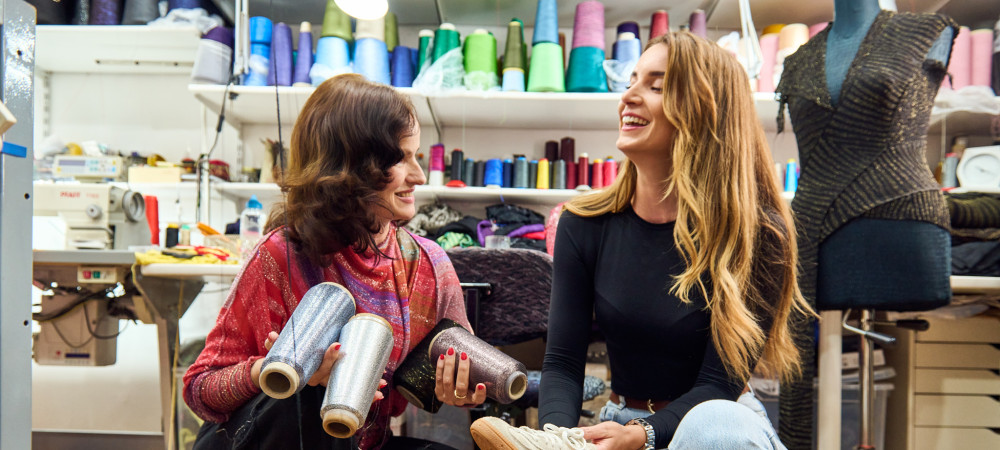
Create Your Own Shoelaces at Studio Draž
Viva Creativa: threads and colors – transform your regular shoes into a unique pair with shoelaces by the renowned creative…