
Špela and Rene Šuc (Gostilna pri Mari)
We spoke with Špela Šuc and Rene Šuc, the third generation to carry on the story of the family-run Gostilna pri Mari in Kamnik pod Krimom. They shared their approach to blending traditional Slovenian cuisine with contemporary hospitality and sommelier expertise, finding inspiration for new interpretations of age-old recipes, and maintaining a balance between family and business life.
We learned how each of their independent career paths eventually led them back home, where, together with their family, they welcome guests who know that a roughly 30-minute drive or 15-minute train journey from Ljubljana will be rewarded, time and again, with a slightly refreshed, carefully considered and complete culinary experience.
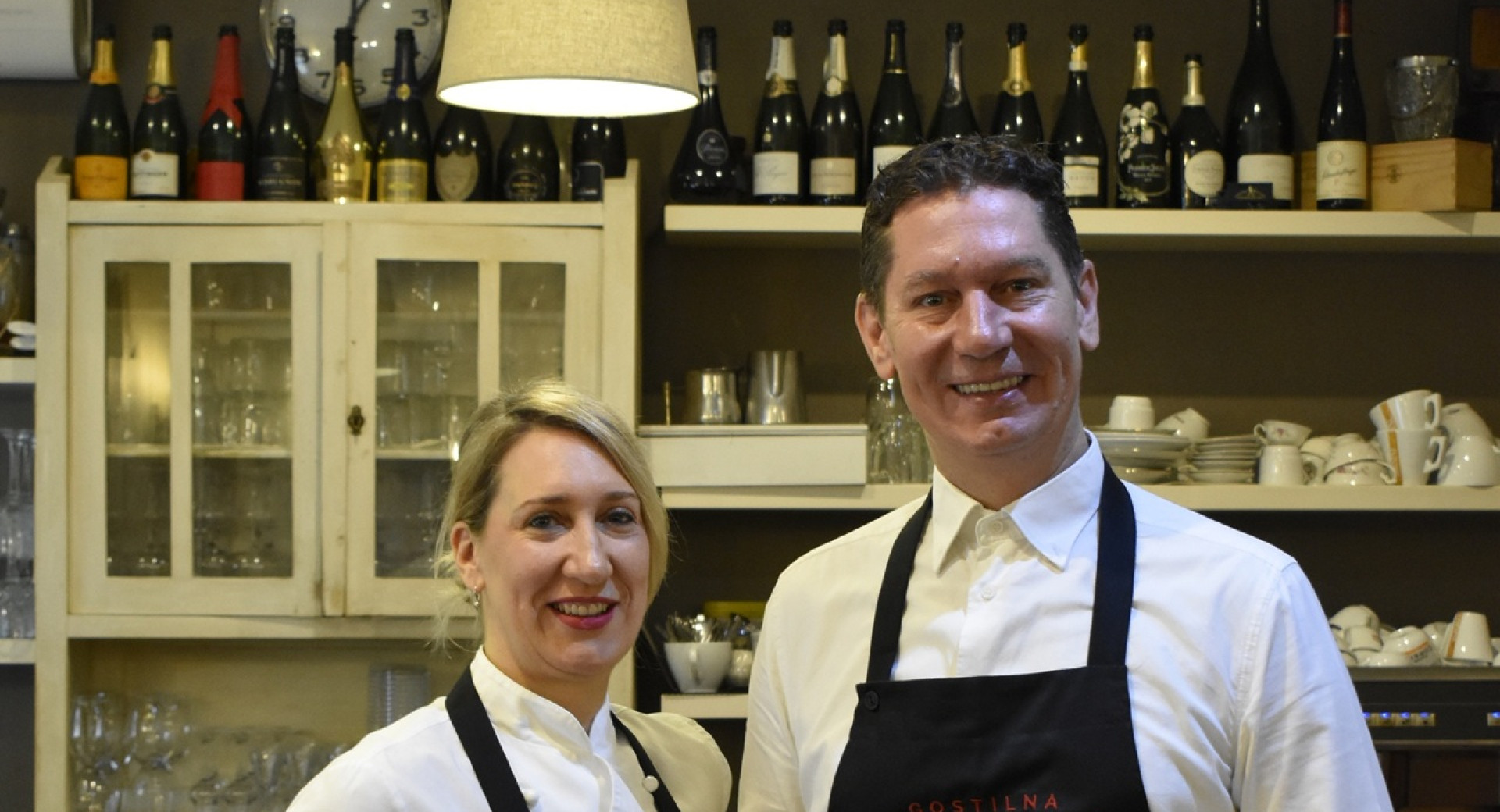
You are the third generation of the family running Gostilna pri Mari. Did you always know you would “stay at home” and take over the family inn, or were your childhood and teenage aspirations different? What kind of responsibility do you feel toward Mara’s legacy, and how do you balance the proven practices of your predecessors with the modern ideas you introduce yourselves?
Rene: Like many boys, my first childhood dream was to become an athlete. Later I had the idea of becoming a lawyer, but soon after primary school, when I came back down to earth regarding my grades, it became clear that I would stay in hospitality, a profession I had always enjoyed. From a very young age, I helped out at home, both in the kitchen and in service. At first, these were basic tasks, washing glasses at the bar, stocking fridges, sweeping, and in the kitchen helping with preparation, peeling potatoes, bringing ingredients, cleaning vegetables, and so on.
After primary school, I enrolled in a hospitality secondary school. At the time, there was a four-year programme for hospitality technicians that combined service and kitchen training. After finishing school, I quickly got a job in a restaurant in Ljubljana. Before that, I completed an internship at the highly regarded Restaurant Rotovž under the guidance of Mr and Mrs Smuk. Only later did I fully realise how much I had gained from that time. I was introduced to around 50 different wine labels and to a professional approach to service and cooking. From there, I drew many ideas for my future work, from more elaborate table settings to service style and communication with guests.
After a short time in my first job, it was time for military service. I then worked for a year as a protocol waiter at the Ministry of Transport and Communications, and later continued as an assistant and eventually head of service at Casino Ljubljana, where I stayed for 10 years. Throughout that time, I also worked at home, helping my parents. In 2009, I took over the business from my mother and we began building a new story.
Špela: I never saw myself working at home, and I had no desire to work in hospitality. I imagined a career in banking. After finishing secondary school in economics, I studied marketing, but I had always worked at home as well. From a young age, I was in the kitchen, never in service, and I always enjoyed helping. No one ever pushed me into it, quite the opposite. Still, instead of staying upstairs with my books, whenever I saw a full parking lot through the window, I would go and help in the kitchen.
As a result, my studies took a bit longer, but during that time I gained a great deal of work experience. After graduating, I worked in marketing at a winery in Vipava, where I came into contact with wine marketing, met many oenologists, and got to know the world of wine in depth. That was when the idea began to grow that I would one day take a sommelier course, which I later gave to myself as a 30th birthday gift.
This was a major turning point for me. I met a wonderful group of people there, and we connected extremely well. Through them, I realised that we all face similar challenges when working in family businesses. Every family business has comparable issues that can somehow be worked through. When you see that ten people around you are in a similar situation, it becomes much easier to deal with. These situations can be demanding, when business, family and personal relationships mix, disagreements inevitably arise.
Rene: Or rather, disagreements always arise, because there are different generations, different perspectives and different habits.
Špela: I think it is like that everywhere, even if you work in a company that is not family-run. Sooner or later, you have to deal with relationships. When the added factor is that your first colleague is your mother or your brother, it becomes even harder, because there is no distance or barrier, and you sometimes go further than you should. That is always a challenge. Still, since 2011, when I started my sommelier training, I have been working at home.
Rene: I would also add that we both continuously educate ourselves in hospitality. I completed my first sommelier level very early, in 1999, when I was among the first generation of Slovenian sommeliers. Alongside work, I also completed a higher vocational programme in hospitality and tourism in Bled. Recently, we have both been focusing more on wine. We have both completed WSET Level 2 and attended the WSET Level 3 course, although we have not yet taken the exam. That is our next goal.
Špela: Knowledge keeps building all the time. When you work at home, it is important to always have new challenges and goals, to keep learning. It breaks the routine, you meet new people, gain perspective and motivation.
Rene: Our common thread and shared philosophy, which we aligned on very quickly, is “less is more”. A shorter menu where every dish is of top quality and full of flavour. That way we can focus on ensuring both the kitchen and the service are at the right level. Even though we are a traditional countryside inn, the service is restaurant-style, and the plates are presented with a bit more elegance.
It is a specific challenge, how to serve home-style food in a slightly different way. You use different plates, replace a tomato slice and a piece of lemon with more modern decoration. It also means a lot that we have our own garden, where we grow a large amount of herbs and some vegetables, so you can always find something fresh to complement a dish.
Of course, the foundation is fresh, seasonal ingredients, with no shortcuts using frozen products. We shop for fresh ingredients on Wednesdays and Fridays. This is essential for the flavour that ultimately delights our guests. Even though no one in the family has formal culinary training, the feedback from guests is enthusiastic, which shows that we are doing something right.
How do you divide the work in the inn? Do you have clearly separated areas of responsibility, or do your roles overlap?
Rene: In principle, Špela is responsible for the kitchen and the garden, and also the presentation. My part is the technical side, organisation of the business and service, although we do share some areas.
Špela: The work definitely overlaps. Sometimes Rene comes up with an idea and suggests something new for the kitchen. Even if I do not agree immediately, I always take it into consideration, because he is also an excellent cook. It often happens that his ideas end up on my plates. At the same time, I sometimes suggest an interesting winemaker, and Rene includes them in the offer. It works both ways.
At our place, everyone knows how to do everything. I can jump into service if needed, and if I am overwhelmed in the kitchen and Rene has everything under control, he can step in and help finish things. I cannot use him for everything, but he definitely handles the salads well. (laughs)
Your menu emphasises traditional recipes, refreshed with modern culinary knowledge, and high-quality seasonal ingredients. How often do you change the menu during the year, and how many dishes remain unchanged? Is there a dish on the menu that you have been preparing using the same recipe since the very beginning of the inn?
Špela: The beef soup is definitely prepared in only one way, exactly as it has been since Grandma Mara. I have never changed the recipe. The same goes for the fried chicken.
Rene: We have a few fundamental elements typical of traditional Slovenian inns, beef soup, sautéed potatoes, fried chicken, and roast veal or pork.
Špela: There is always something “from the oven”, it can be veal roast, veal shank, different cuts of pork. The cuts change, but there is always some kind of home-style, slow-roasted meat available. Otherwise, we follow the seasons. A dish may stay on the menu but with a seasonal touch, and we often take inspiration from the garden. Now it will be young salads, young spinach, young beetroot.
We both also like to travel. When you explore the world, you gain a different perspective and broader understanding, and ideas come that you can bring back home.
Rene: The biggest difference between the menu from the early days of our inn and today’s offer is that we have expanded the classic formula of soup, main course, dessert. We now offer three cold starters, three hot starters, fewer main courses, around five or six, and a few more desserts. This reflects our awareness of global culinary trends and our experiences from travelling.
Where else do you look for inspiration for new recipes and menu updates? What culinary style, besides traditional Slovenian cuisine, is closest to you, and how does it influence your menu? Is there a dish on your menu with a particularly interesting story behind it?
Špela: Recently, I started preparing vitello tonnato, which I have often eaten over the past ten years while skiing in Italy. I had wanted to prepare it for a long time, but there was never really an opportunity. Last autumn, we had an event for a more demanding client, and I presented my idea. I have to say it turned out very well, the guests’ response was phenomenal. Because the dish has to be prepared really fresh, I only include it on the menu on weekends when I am sure there will be enough demand. Since we have many regular guests, it is easier to plan things like this.
Rene: I also have an interesting story. As I mentioned before, one of our basics is roast veal. When the children were still small, we spent six consecutive years on holiday in Dalmatia. We stayed with the same host and became good friends. There, veal is traditionally prepared under the bell, and I fell in love with it. I later tried to recreate it at home. We tested it on the menu, the guests loved it, and it became a popular permanent dish.
Špela: I like to try very diverse food, from classics to Asian specialities such as sushi. In the end, though, simplicity wins, dishes made from good ingredients, like classic Italian cuisine. Recently, I was in Valencia, where I was impressed by their pata negra ham. We now regularly offer it at the inn and slice it fresh by hand. Simple cuisine with top-quality ingredients is coming back into focus.
Rene: I am also in love with Italian cuisine, probably because we have roots in the Primorska region. My father is from there, and we spent a lot of time there when we were young. We also used to shop in Italy because some things were not available here. So, no complications, good meat, good pasta, and good wine. That is it. I have also been impressed by Thai and Chinese cuisine while travelling. But among our guests, we are currently noticing a strong desire for authentic, home-style food.
Špela: Recently, we added a retro dish to the menu. I do not even remember whose idea it was. It is a simple veal steak in natural sauce with an egg, as it used to be served. It immediately became a success, the response even surprised us a little.
In Ljubljana, the offer of global cuisine is growing rapidly, street food with various influences and the bistro concept, which is great. But for the weekend, we still like to go to a classic inn. Dishes like sautéed potatoes and beef soup are part of Slovenian DNA. After every trip, we crave a good beef broth and a bowl of homemade salad.
Rene: And a good piece of boiled beef from the soup with a bit of horseradish, a classic you cannot go wrong with.
Since you are both trained sommeliers, how do you curate your wine list? Are your guests more inclined towards traditional choices, or are they open to more modern wine trends? Which wine must never be missing from your offer, and which one might surprise a guest?
Rene: We started with a very classic wine list featuring established winemakers, which we entrusted to experts. That was at the beginning, when we did not yet have as much knowledge. Soon after, we began discussing a different approach. Why not represent lesser-known winemakers who are just entering the market and present their excellent wines in our inn?
Now we follow this approach. We continuously rotate winemakers, work with them directly, taste together, and then include in the list what impresses us. We try not to reject anyone outright and give everyone a chance. Then we present both the winemaker and the wine appropriately. In the end, guests also help guide us. If the response is weaker, we replace the wine. If it is good, it stays. That is how we move forward.
Špela: At the moment, the trend is moving towards fresh wines, slightly away from natural and orange wines, which were popular over the past decade. We covered those quite a lot as well, but now the trend is shifting towards clean, elegant wines.
Rene: Since we are a traditional Slovenian inn, we have so far stayed within Slovenian wines. However, our next goal is to expand in this area. Soon we will add a few international representatives to the list, some French, some Italian, maybe a couple from Germany, such as Rieslings. I think people like to see something new, especially our regular guests. Even something as simple as a glass of wine can be enough. It also opens up conversation and helps us build relationships with our guests.
You have been part of the popular Open Kitchen food market in Ljubljana for many years. What do Fridays spent in the lively atmosphere of the Ljubljana market mean to you? How do they influence your work at the inn, and has your presence at Open Kitchen changed Gostilna pri Mari in any way in the long run?
Špela: Since I am usually “backstage” at home, I really enjoy going to Open Kitchen on Fridays, being among people and in touch with what is happening. Once a week is just right to break the routine. If it were more often, it would be too much. It is very demanding, but we enjoy it. You meet people, there is always something new, you talk to people and present your work. The long-term effects are definitely positive. We have gained a lot of new guests, so it is both good business and good marketing. Many guests first discovered us there.
Rene: We joined Open Kitchen primarily with promotion in mind, which was also the original purpose of the project. Since we are not located in Ljubljana, but rather on the outskirts and a bit hidden, people do not find us on their own. Our marketing has always been based on word of mouth. We have never advertised in newspapers, on the radio, or anything like that. For an inn, that is the best kind of marketing. Open Kitchen gave us a real springboard to present ourselves to a younger audience in Ljubljana and the surrounding area. Many visitors who first encountered us at Open Kitchen now visit us regularly, both at Pogačar Square and at the inn.
Špela: It is very important to us that we are the ones present at the stand, and that we do not send other staff in our place. This means we cannot always be there, but whenever we are, guests get exactly what they come for. The inn is a complete package, and our personalities are inseparably connected to the business. Some guests are used to coming “to Rene”, others go “to Špela”, and sometimes they even rename me and I simply become Mara. The inn is part of you, that is just how it is.
Running a family inn also means constantly balancing private and professional life. How does your family navigate these challenges, and when do you take time to be “just a family”? What do you like to do then?
Rene: Hospitality is a way of life. Our private life is intertwined with the inn, or the other way around. Personally, I would say I have a bit more private life, because I live elsewhere with my family. Špela, who stayed at home and lives in the same house, gets the most of her private time when she travels. We do not spend our free time together, because we work together every day. We spend it individually, doing the things we enjoy. I mostly spend it with my family.
Špela: In summer, we always take a three-week holiday separately, so we can rest from each other and from the inn. Otherwise, we spend around 10 hours a day together, the two of us, as well as our parents, who are still very active. Then there is also an aunt and other extended family members, sometimes even Rene’s wife or son. So family time actually happens in between service. (laughs) Of course, we do organise the occasional birthday celebration or picnic together, open a good bottle of wine, but then that is enough.
How active are your parents today, the ones who passed the inn on to you? And who listens to whom in the inn?
Rene: They are very active and help a lot. My father is 78 and my mother is 72, and they are still involved in the inn from morning until evening.
We listen to them, while they listen to us a bit less easily. Sometimes you need a small argument to really hear each other.
Špela: We are all strong personalities, so from time to time someone insists a bit more on their point of view, but we always work through it and find a middle ground. Ideas come from both sides. It is clear that they have a different perspective, as they have been part of the house and the business for much longer.
What are your favourite restaurants and bars in Ljubljana and the surrounding area? Where would you send a guest visiting Ljubljana for the first time?
Špela: If I have a free evening, I really enjoy going to Ljubljana, especially Wine Bar Šuklje, because I know the team, we also trained together, so the visit is both a pleasure and a bit of a challenge. I roughly say what I feel like drinking, and Ožbej or Simona already know what to bring. I also like to eat at Barra, and occasionally treat myself to fine dining at Strelec. If there is something new in Ljubljana, we sometimes meet with Mojca Mihovec and Margareta Kukljeva, three restaurateurs, and try it out together.
Otherwise, I would recommend visitors explore as much as possible. Ljubljana has a huge variety of options, coffee, beer, wine bars, cocktails. Silk and Fizz is excellent, for example. For food, I would of course first invite them to our place, but otherwise everything is within reach and everyone can find something for themselves.
Rene: I spend more time with my family in Istria and Italy, so I am probably not the best person for recommendations. I would highlight Vinoteka Koželj, though. We have a very good collaboration with them, they organise tastings with new winemakers and visits to wineries, and I really enjoy that comprehensive approach.