
MMM STORIES: DAPPER
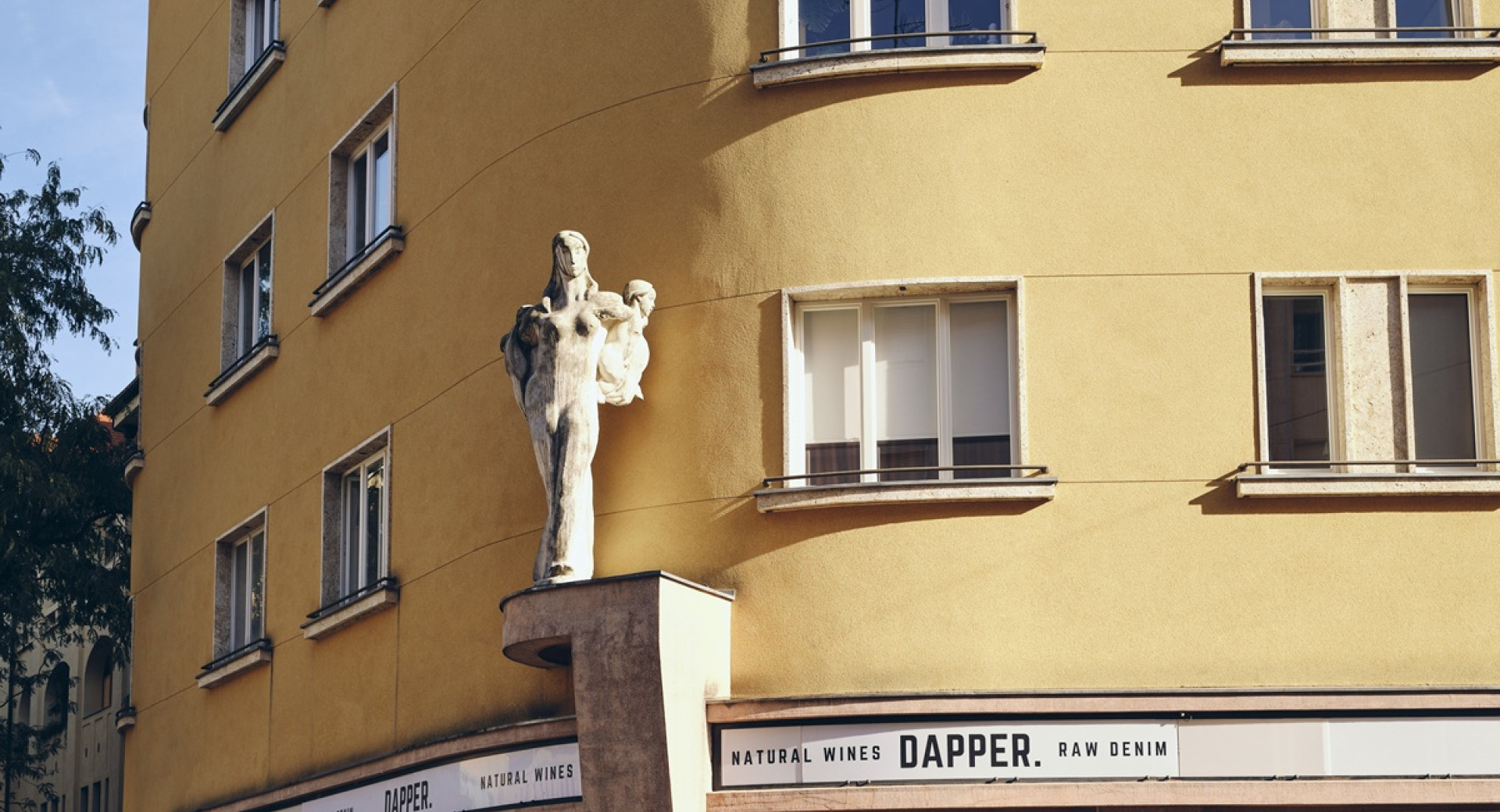
When you next cut past the Drama Theatre and slip onto Igriška Street, pause for a moment. Feel the pulse of this residential lane that somehow is and isn’t part of Ljubljana’s city centre – equal parts historic charm and contemporary urban energy. Then turn left and step inside Dapper. Before you wonder why raw denim garments, a curated selection of natural or low-intervention wines, boutique cured meats and a lively 80s soundtrack coexist in the same space, meet the man behind it all: Primož Stayer, the owner of the small but seriously characterful boutique Dapper. After a few sentences, you’ll see it clearly – the red thread tying Dapper together is Primož himself.
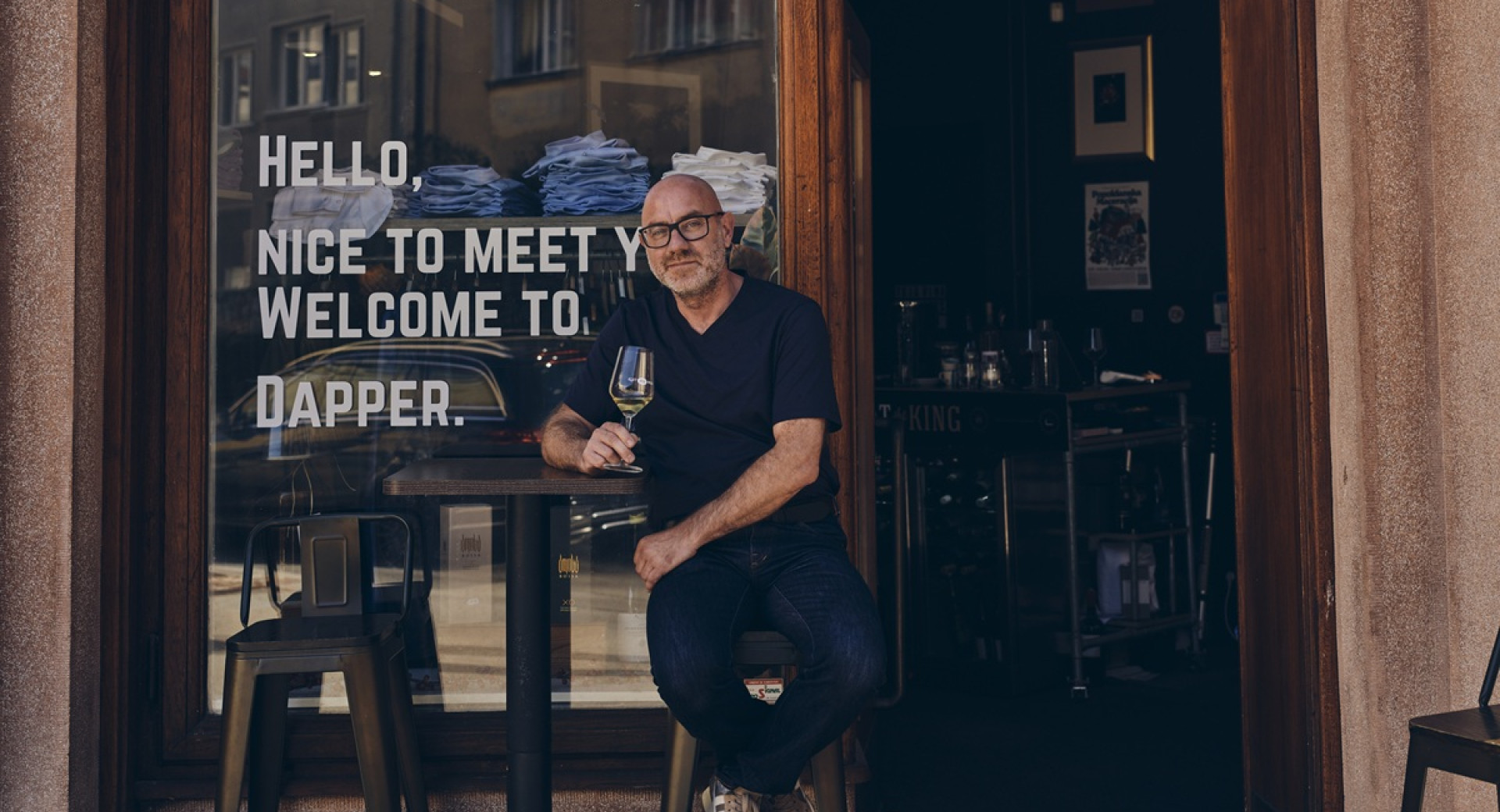
Well mannered and impeccably presented
Though the story began long before, we’ll start with the name. Dapper is an old English word used to describe a man who dresses – and carries himself – with refined elegance. He’s dignified in a timeless, almost old-world sense, yet effortlessly in step with the present. Above all, he’s polished, composed, and ready to enjoy good things in good company.
But here’s the twist: Dapper wasn’t really planned at all. Much like a master winemaker who crafts exceptional natural wine from superb grapes using minimal intervention and a profound understanding of the process, or a tailor who creates garments meant to last a lifetime, Primož has channelled decades of business experience and a long-standing passion for craftsmanship into a venture that radiates infectious joy. A shop that blends the sale of quality products with long conversations over excellent wine and carefully chosen bites; that builds a community of like-minded people; and that looks to the future with a deep understanding of the past.
Raw and spontaneous
In this light, it suddenly makes sense that Dapper wasn’t designed or planned, but instead grew organically, almost by itself. Pinpointing the true beginning is difficult. Was it during the turbulent times of the pandemic, when Primož and his business partner Tomislav from Zagreb decided to close a 30-year chapter of producing workwear and protective gear, and instead channel their knowledge into evia, a slow-fashion clothing brand? Or was it perhaps on his first trip to Sicily, where he discovered a new hobby – one that slowly, steadily evolved over 15 years into a career of distributing and promoting natural wines? Then again, the story might have started four years ago when he heard that a space on Igriška Street was becoming available. Curiosity led him inside Nemška hiša (German House), a magnificent Art Nouveau building – and in an instant, he saw everything Dapper would become. In truth, the story feels like it was always meant to be. And although it simmered for years, its final form is refreshingly unrefined – raw in the best possible sense.
Traditional and trend-forward
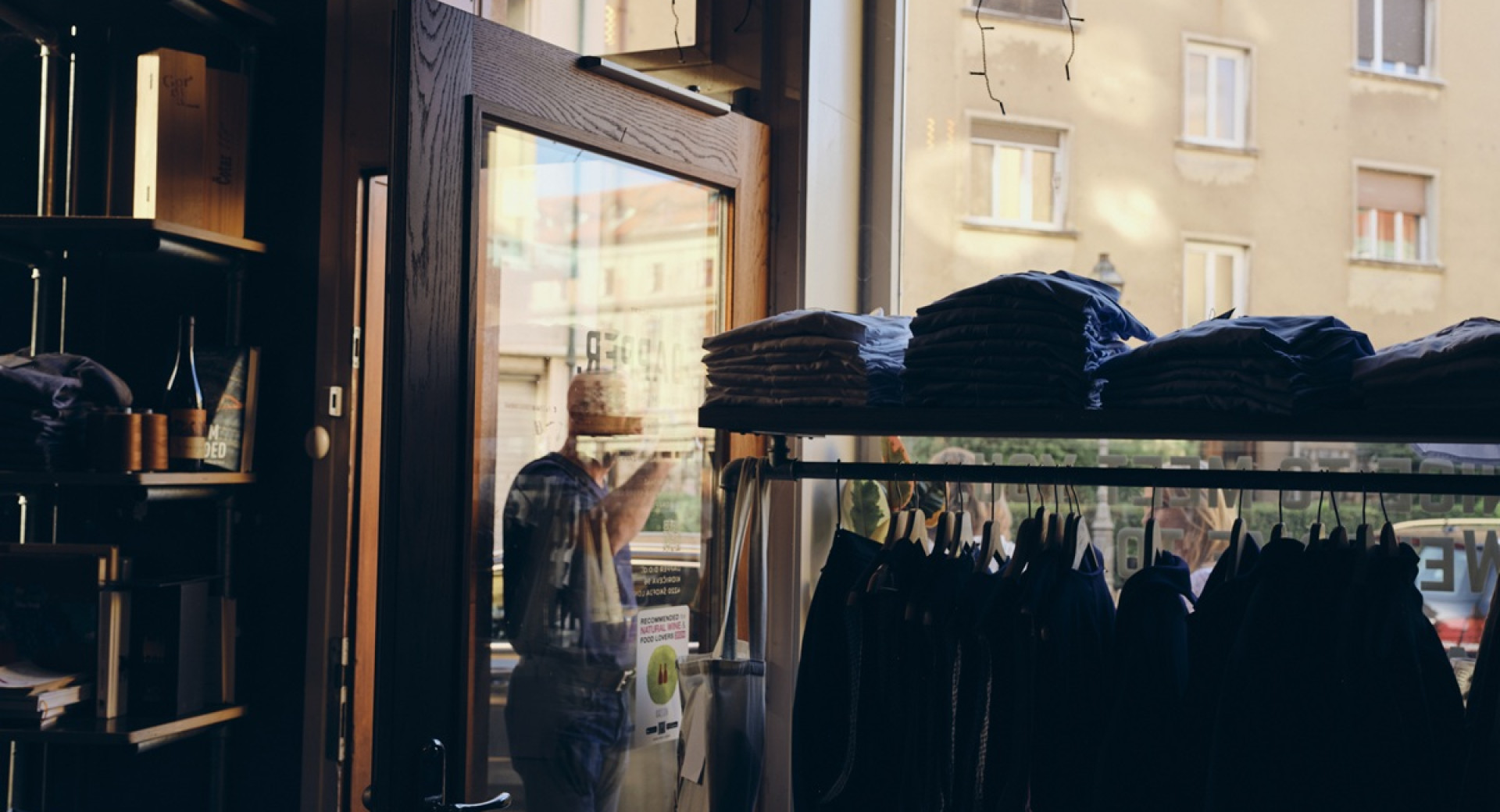
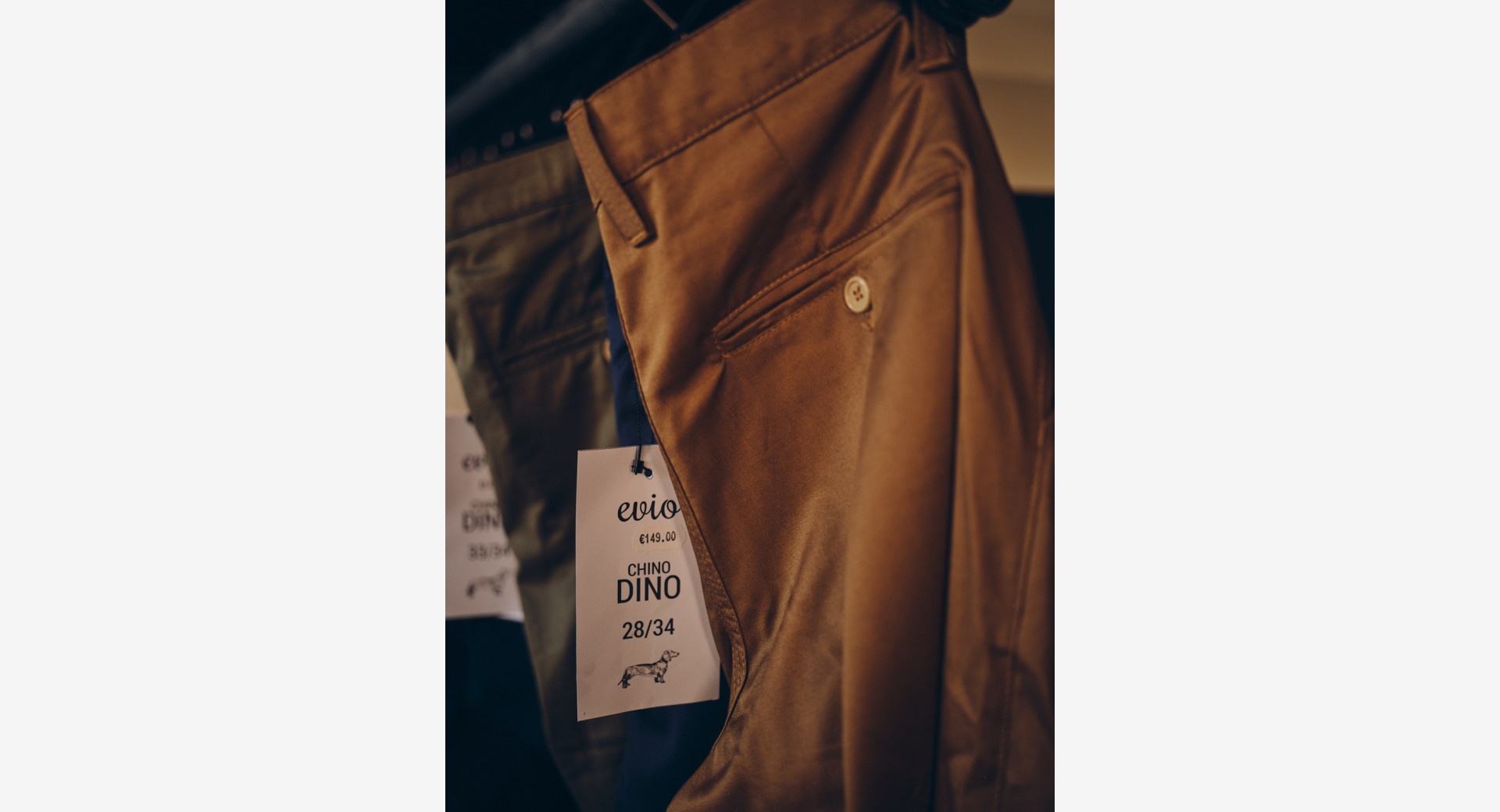
The left-hand side of the shop is devoted to raw denim garments (which the less informed among us might mistakenly call ‘jeans’) and other high-quality materials, all sourced within a 500–600 km radius of the boutique on Igriška, and tailored in small-scale production in Zagreb. To understand why some people (for now, mostly people abroad) swear by raw denim, one must step back into the history of the fabric Slovenians now simply call jeans.
“Until the mid-80s,” Primož explains, “all denim was raw denim – unwashed, untouched by bleach or pumice. After sewing, the fabric was left as is. Only later did denim start being pre-washed, faded, torn, distressed… but a few smaller brands and individual departments at big brands (e.g. Levi’s) kept the old ways alive. The fabric is completely raw – the trousers, jackets and shirts aren’t washed or treated in any way. From that point on, it’s up to the wearer to decide how the story continues. The practical advantage is that raw denim moulds itself to the individual. At first it can feel a little rigid, but after 10–14 days it becomes part of the person wearing it – it adapts completely to the shape of the body.
We work exclusively with selvedge denim (self-edge) – fabric woven on old shuttle looms that largely disappeared after 1955. The Japanese, who fell in love with American subcultures, bought countless machines and brought them back to life. Why? Although modern looms produce fabric that’s roughly twice as wide and much faster to make, there’s a catch: the edges look frayed and need to be hemmed. Selvedge looms finish the edge on both sides, creating a clean border that, with a bit of imagination and a coloured thread or two, becomes a beautiful design detail. Raw denim is often worn with a turn-up, and selvedge denim has that distinctive edge that is immediately recognised by true enthusiasts who swear by raw denim. It’s become something of a cult element that catches the eye of every true connoisseur. The fabric has a different structure, a different texture, a different feel. Tiny imperfections make it authentic”, explains Primož as he demonstrates the red-and-white selvedge line hidden inside a neatly folded trouser leg – pulled from the shelf with the ease of someone who knows every piece by heart – and brings the entire history and charm of these garments to life.
Dignified and wild
Suddenly it becomes obvious why the right-hand side of the shop – filled with natural wines – completes the left so perfectly. The thread tying everything together is clear: locality, sustainability, provenance, quality, and a deep respect for the makers and the people who buy their work.
“The wines are mostly Slovenian: Tokaj, Blažič, Keltis, Renčelj, Čotar, Gordia and many more. And the cellar holds plenty from abroad too: Austria, Italy, France, Spain, Georgia. I know every winemaker personally, and that matters to me. My entire wine philosophy is based on organic or biodynamic farming and spontaneous fermentation without added yeasts, but that alone isn’t enough. I want to know the winemaker, feel their energy, and make sure their wine brings a bit of that energy into Dapper.
When we talk about wine, it needs to be well made, without unpleasant faults. I don’t mind a slightly elevated volatile acidity, but in principle the wines must be technically sophisticated. And natural wine is always a walk on the edge. Natural wines have changed over the years with most moving toward a more elegant expression, which I like. When I first got into them, I preferred the rustic ones; now less so. Your palate changes as you learn. Customers have changed too. There are fewer people looking for extreme orange wines with strong tannins and oxidative notes – people have had their fill of that. But I’m glad winemakers can still make the kind of wines they want. Because winemakers focusing on quality produce such small quantities, there’s always a market somewhere for their products, regardless of the style, considering the sheer size of the global market. Locals lean toward elegance; heavier macerations are sought after by Scandinavians, the English, Americans – it’s new and exciting for them. All of this must be taken into account when selecting the wines – but fortunately it aligns rather well with my own instincts,” Stayer explains as he describes how he selects the bottles that land on Dapper’s shelves.
Respectful and community-minded
But Dapper is more than a shop. It’s a place to taste, chat, unwind – and a part of a broader community: the residents and small businesses of Igriška Street, and beyond. Patrons leave with wine, garments or delicacies – but also with memories of laughter, new and exciting flavours, and oftentimes recommendations for their next adventure. The community spills far past Igriška Street, Ljubljana and Slovenia. Just as Dapper sources products from within 500–600 km, its customers carry their stories outward into the same radius. Primož himself often heads out as well – to cook at JB Restaurant, prepare porchetta for Movia Wine Bar, or co-organise the Karakterre Festival in Austria with his Zagreb colleagues Marko Kovač and Niko Đukan.
Though he likes the idea of “sustainability”, Primož prefers a different word: respect. When we treat our environment and the people around us with respect, we create something truly genuine – something that attracts others who share the same values. That’s how communities form, support each other, and grow stronger.
“I feel I’ve created something that gives me immense joy, making it easier to cater to our patrons’ wishes. Nothing here is forced. This is authentically me, and I don’t see it as work. I live here, and I live this. Somehow, in the most spontaneous way, a beautiful space has emerged – a place people truly enjoy returning to, full of good vibes, laughter, natural wine, and shared moments. I bring in people who want to elevate simple products, and who are genuinely good human beings. I’m happy that cooperation keeps growing, and I like to think I’ve contributed to that,” Primož, the person shaping the future of Dapper with a bow to the old world – right here, right now, tells us modestly.
© Suzan Gabrijan

© Suzan Gabrijan

© Suzan Gabrijan

© Suzan Gabrijan

© Suzan Gabrijan
© Suzan Gabrijan

© Suzan Gabrijan
© Suzan Gabrijan