
Art That Interrupts the Everyday and Takes Us by Surprise
Play audio recording of content
At LUV Fest 2026 in Ljubljana, a city-wide celebration of love, art, and wandering, the public space itself becomes a gallery that surprises and engages everyday passers-by. The festival’s central art installation is “Brstenje” (Sprouting), conceived and realised by intermedia artist Nika Erjavec. Installed along Čufarjeva Street, Brstenje uses light, organic motifs, and the urban landscape to evoke the quiet energy of spring and the awakening of nature, the city, and its people. This luminous work embodies the festival’s spirit of interrupting routine and inviting fresh perspectives - a vibrant backdrop to the following interview.
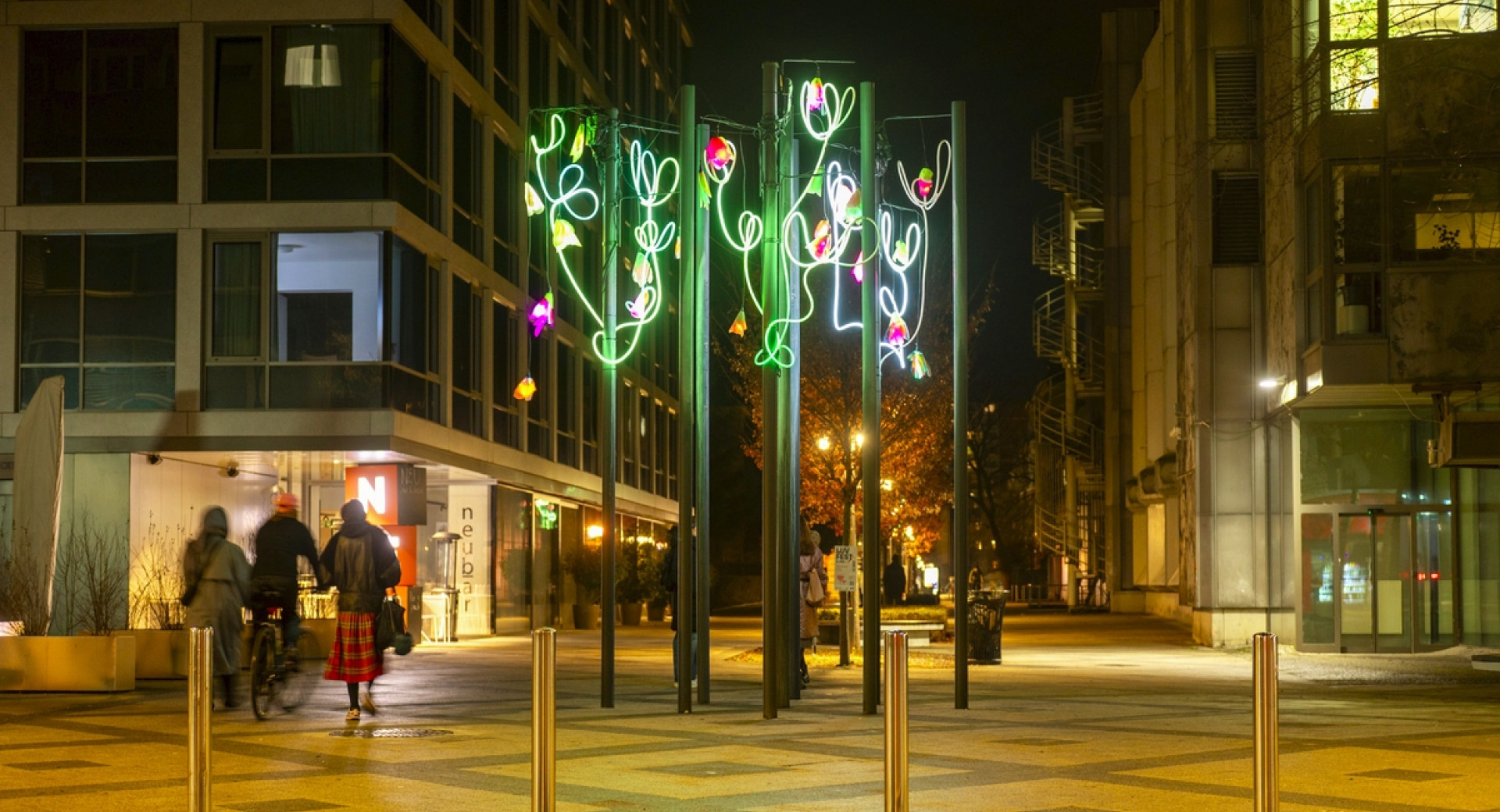
On Čufarjeva Street, just beyond Ljubljana’s historic old town, spring has arrived ahead of time, ushered in by a luminous installation composed of stems, shoots, buds, and blossoms that evoke the quiet drama of growth and transformation. Sprouting (Brstenje), the new central artistic installation of this year’s LUV Fest, is the work of intermedia artist Nika Erjavec, whose works explore vibration, urban wilderness, and the limits of human perception. Installed on one of the city’s newly renovated streets, the piece feels especially resonant. As Erjavec reflects, renewal itself is a kind of spring.
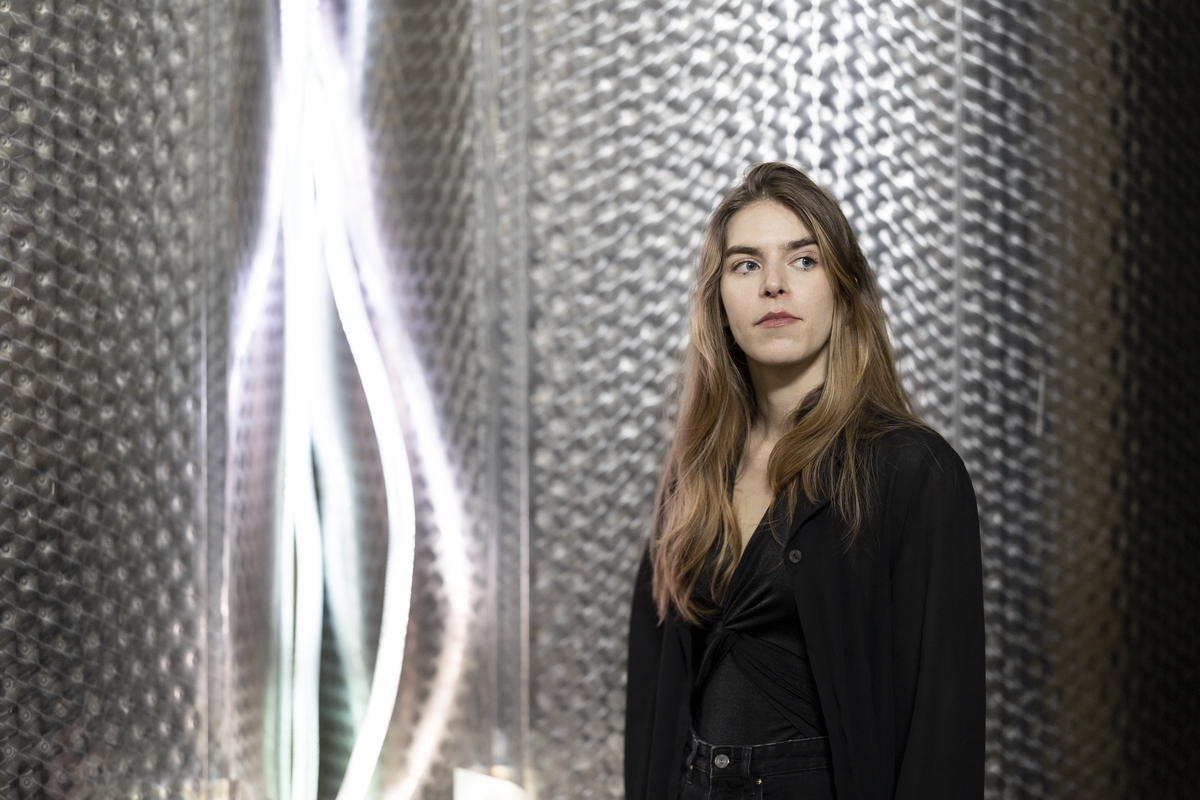
Nika Erjavec completed her Master’s degree at the Department of Sculpture in 2021 after graduating in Unique Design at the Academy of Fine Arts and Design in Ljubljana.
Last year, she received the OHO Award, Slovenia’s central national prize for young visual artists. She was awarded the Prešeren Prize of the Academy (University of Ljubljana) in 2019 for her (in)VISIBLE installation series and hybrid artistic research project. Over the past decade, she has presented her work at numerous solo and group exhibitions in Slovenia and abroad.
The colours and patterns employed by the artist are inspired by the world as perceived by pollinators — bees, butterflies, and other insects - as noted in the presentation of the Sprouting light installation. What sparked this idea?
“The inspiration stems from two directions,” she explains. “One relates to perception, which is central to my work. In the context of light-based art, I explore how pollinators perceive parts of the light spectrum invisible to the human eye. “The other source is deeply personal - my relationship to the transition from winter to spring. That’s when I, too, begin to sprout,” she smiles. “I love that shift - how muted greys suddenly give way to vibrant greens, how the scents change, and how birdsong becomes brighter and more insistent. Seasonal transitions are profoundly inspiring.” She also recalls a vivid childhood memory of winter turning to spring: her mother once made her a beautiful spring-inspired costume, a budding meadow teeming with flowers. The installation responds directly to its setting – the newly renovated Čufarjeva Street. The summer misting nozzles, dormant through the winter months, have themselves ‘sprouted’, while the street lamps — already reminiscent of delicate snowdrops — become part of the composition. “I enjoy working with public space and always begin from it,” Erjavec says. “Through subtle interventions, I sometimes reframe urban elements that might otherwise remain passive, offering passers-by a fresh perspective on the city.”
Outdoor art has the power to reach a wide audience. How important is it to you that art appears where it can reach as many people as possible?
“Extremely important,” she says. “I try to direct as much of my work as possible into public space and encourage others, especially my students, to consider the value of this approach. “Sprouting invites direct dialogue - with individual elements and with the newly revitalised street itself. While setting up the installation, we were already getting lovely feedback from residents and passers-by, children and adults alike. “I find it precious when art appears in places where it can surprise us - when we don’t have to deliberately seek it out, but rather when it interrupts our daily routine in broad daylight. Art should be part of everyday life. It can reveal the city from another angle.”
Urban wilderness and people’s attitude towards the natural environment frequently feature in your work. How did these themes move to the forefront of your creative endeavours?
“I belong to a generation (N.B. Nika was born in 1994) that grew up hearing about the environmental crisis from primary school onwards,” she says. “We’ve been saturated with information about its causes and consequences, yet the world is not ready and meaningful systemic change remains elusive. Responsibility is often placed on individuals who, in reality, have limited power. “Urban wilderness feels like a symptom of our time. These are spaces once used by humans and then abandoned - yet within that abandonment, resilient, biologically diverse ecosystems emerge, often more vibrant than the city’s manicured green spaces.” Erjavec regularly visits such sites, collecting plants that are one of the lines of materials she uses in her work. “Through my choice of materials, I seek to create an associative field for the viewer. And not only with natural materials, but also with those that form part of our living environment and material culture - concrete and rebar, for instance, as well as plastic and consumer electronics. In doing so, I allude to the striking fact that in 2020 the combined weight of our built and material culture exceeded that of all living matter on the planet - the Earth’s entire biomass. “These urban wilderness spaces can serve as glimpses of the future,” she reflects. “They remind us how interconnected everything is.” I, however, see them as beautiful and intriguing spaces, which further testify to the fact that humanity’s endeavour to bring nature under control never truly succeeds.
In your experience, how strong an impact can art have in raising awareness?
“Of course, I would like to say that art is a powerful and effective medium in every context,” she says, “but that would be rather idealistic.” “Art in museums and galleries,” she notes, “is currently in contact with a numerically limited audience - one in which many people may already be aware of what the artist wishes to communicate. In a sense, it often speaks to the already convinced.” She sees a far greater, largely untapped potential for art in primarily non-artistic spaces, and especially in connection with science and technology. “These fields constantly bring new discoveries that we struggle to keep pace with or fully understand,” she explains. “As a society, we are losing the capacity to make informed decisions about new technologies and scientific breakthroughs. If you don’t understand something, it is difficult to anticipate the full scope of its potentials and consequences - both positive and negative.” It is precisely at this intersection, she suggests, that art can assume a more direct role. “Art can open up new perspectives and help us grasp the broader, sometimes hidden contexts of such developments. It can render the abstract more comprehensible and bring scientific and technological progress — with all its potential and pitfalls — closer to a wider public.”
Returning to urban wilderness: could you reveal some such spaces in Ljubljana?
“One beautiful example of urban wilderness, which also holds potential for the future, is the so-called Crater (Krater) near Dunajska cesta,” she says. The site has remained a construction pit for decades, originally intended for a new courthouse. Over time, however, a green space has stubbornly taken root there - now a wild park, at moments almost a young forest, with a striking mixture of native and invasive plant species. One can even spot shrubs that appear to have escaped into the park from the balconies of Bežigrajski dvori. She also mentions the construction pit at Tobačna, where water has flooded the concrete foundations, forming large pools across the site. “Perhaps slightly less romantic,” she adds, “are the roadside verges, forgotten grassy strips and semi-wild parking areas along the railway lines, where heavy goods vehicles pull in to rest, carrying seeds in and out on their wheels.”